What a solar PV tester measures, the IEC 62446-1 tests, PV testers vs I-V curve tracers, 1000 V vs 1500 V, popular models compared and what to buy for projects in Jordan. From EE Electronics, Amman.
In this article
Key takeaways
- A solar PV tester measures what IEC 62446-1 requires at commissioning: earth continuity, polarity, open-circuit voltage, short-circuit current, insulation resistance and, on larger systems, the I-V curve.
- Choose by system voltage and current first. Rooftop and C&I systems in Jordan mostly run up to 1000 V DC; utility plants use 1500 V, and modern large-format modules can exceed the 15 A limit of many testers.
- A multifunction PV tester proves the installation is safe and wired correctly. An I-V curve tracer proves it performs. Larger projects need both, plus an irradiance meter and a thermal camera.
- Check the module efficiency limit of any I-V tracer. Some instruments are specified only for modules up to about 19% efficiency, below many of today’s modules.
A solar PV tester is the instrument that turns a finished solar installation into a documented, bankable one. In Jordan, where tens of thousands of rooftop and commercial systems are connected under net metering and wheeling, and large plants feed the national grid, every installer, EPC contractor and maintenance team needs one. The question is which one. Instruments range from handheld solar clamp meters to 1500 V I-V curve tracer kits costing several thousand dinars, and buying the wrong class of instrument is an expensive mistake.
This article from EE Electronics, a supplier of test and measurement equipment in Jordan for more than 30 years, explains what a solar PV tester measures, which tests IEC 62446-1 requires, how a PV tester differs from an I-V curve tracer, how to choose between 1000 V and 1500 V instruments, and which solar PV tester to buy for your type of project in Jordan. It compares popular models from Fluke, Seaward, HT Instruments and Metrel using their published specifications, and ends with a buying checklist.
Why the solar PV tester matters in Jordan
Jordan has one of the most active solar markets in the region. According to figures from the Energy and Minerals Regulatory Commission (EMRC) for 2025, reported in July 2026:
Add large plants such as the 200 MW Baynouna solar park near Muwaqqar, east of Amman, which produces more than 560 GWh a year, and the picture is clear: thousands of PV systems are installed, inspected, maintained and repaired in Jordan every year. JEPCO alone accounts for more than 35,000 net metering systems, followed by IDECO in the north and EDCO in the south and east.
The regulator is also active. EMRC reported 149 inspection campaigns covering 520 facilities in 2025. For installers and contractors, that means test records matter: a commissioning report with insulation resistance, Voc and Isc values for every string, taken with a calibrated solar PV tester, is the best evidence that a system was built correctly. For owners and O&M teams, regular testing protects the revenue a system was bought to produce.
What is a solar PV tester?
A solar PV tester, sometimes called a PV installation tester or solar panel tester, is a DC-rated instrument designed to test the DC side of a photovoltaic system: modules, strings, combiner boxes and the cabling to the inverter. A good PV tester combines in one instrument the measurements that would otherwise need a multimeter, a clamp meter, an insulation tester and a continuity tester, and stores them string by string for the commissioning report.
Why not use ordinary instruments? Three reasons:
- Voltage and safety rating. PV strings run at up to 1000 V or 1500 V DC, and they are live whenever the sun shines. A PV tester and its leads are rated for these DC voltages.
- Short-circuit current. Measuring the short-circuit current of a string safely needs an instrument designed to make and break that DC current. A standard multimeter cannot do it.
- Speed and records. A plant can have hundreds of strings. A PV tester runs the full test sequence in seconds and stores the results with the string ID, ready for reporting software.
The IEC 62446-1 tests a solar PV tester must cover
IEC 62446-1 is the international standard for testing, documentation and maintenance of grid-connected PV systems, and it is widely used by consultants and utilities in Jordan as the reference for commissioning. It divides the tests into categories. All Category 1 tests must be completed and passed before the Category 2 tests.
| Category | Test | Instrument |
|---|---|---|
| Category 1 (all systems) | Continuity of protective earthing and equipotential bonding | PV tester or installation tester |
| Polarity test | PV tester | |
| Combiner box test | PV tester, clamp meter | |
| String open-circuit voltage (Voc) | PV tester | |
| String current: short-circuit (Isc) or operational | PV tester, solar clamp meter | |
| Functional tests (switchgear, inverter) | PV tester, multimeter | |
| Insulation resistance of the DC circuits | PV tester or PV insulation tester | |
| Category 2 (larger or complex systems) | I-V curve test of each string | I-V curve tracer |
| Infrared (thermographic) inspection | Thermal imaging camera | |
| Additional tests | Voltage to ground (resistive ground systems), blocking diodes, wet insulation test, shade evaluation | As required |
Our partner AQ Electric explains each test in detail in its IEC 62446-1 solar PV testing article. Below, we focus on what each test means for the instrument you buy.
Insulation resistance
The insulation resistance test checks that no current can leak from the DC conductors to earth through damaged cable, a crushed connector or a cracked module backsheet. It is the single most important safety test on a PV array. The test voltage depends on the system voltage:
| System voltage | Test voltage | Minimum insulation resistance |
|---|---|---|
| 120 V to 500 V | 500 V DC | 1 MΩ |
| 500 V to 1000 V | 1000 V DC | 1 MΩ |
| Above 1000 V (1500 V systems) | 1500 V DC | 1 MΩ |
The standard allows two methods: testing each pole (positive and negative) to earth separately, or shorting the positive and negative of the string together and testing the shorted string to earth. The second method needs a tester, or a rated accessory, that can safely short the string. Fluke, for example, notes that its SMFT-1000 can short and test strings of up to 20 A this way.
This is why the maximum insulation test voltage matters. A tester that stops at 1000 V cannot test a 1500 V array to the standard. For 1500 V plants, you need a PV tester rated for 1500 V, or a separate insulation tester such as the 2.5 kV units covered in our Fluke vs Megger insulation tester comparison.
Open-circuit voltage and short-circuit current
Voc and Isc are the quickest health check of a string. Voc should equal the module Voc multiplied by the number of modules in series, corrected for temperature. A string that reads one module’s Voc low has a reversed or bypassed module, a broken connection or a miscount. Isc depends on irradiance, so it is compared between strings measured under the same conditions, or corrected to standard conditions using an irradiance meter.
Comparing strings is powerful. In a combiner box with 20 identical strings measured within a few minutes, a string that reads 10% lower Isc than its neighbours stands out immediately, even without irradiance correction.
Worked example: what Voc should a string read?
Take an example module with a datasheet Voc of 49.5 V at standard test conditions and a Voc temperature coefficient of -0.27% per °C, typical of modern crystalline modules. A string of 20 modules has a nominal Voc of 990 V. The measured value changes with module temperature:
| Conditions | Expected Voc | Note |
|---|---|---|
| Winter morning, -5 °C | 1070 V | Highest Voc of the year; check the tester and system ratings |
| Standard test conditions, 25 °C | 990 V | Datasheet value |
| Spring midday, 45 °C | 937 V | Typical commissioning conditions |
| Summer midday, 65 °C | 883 V | Common in Jordan’s summer |
Two lessons follow. First, a reading of about 883 V on a hot July afternoon is normal for this string, not a fault; a reading close to 839 V would suggest one module missing or bypassed. Second, on a cold winter morning the same string reaches about 1070 V, above 1000 V. In other words, 20 of these modules would be too many for a 1000 V system on a site with frosty winter mornings, as in Amman or Ma’an. That is why system designers limit string length for the coldest expected temperature, and why the tester must be rated above the maximum Voc, not the nominal value.
Continuity and polarity
Protective earth continuity confirms that module frames, mounting structures and equipment are bonded to earth with a low resistance, typically measured with a 200 mA test current. Polarity confirms that each string is connected the right way round before it reaches the combiner or inverter, where a reversed string can cause damage. Earthing of the whole site is tested separately; our article on the earth resistance test explains the methods.
Commissioning a PV system in Jordan?
EE Electronics supplies solar PV testers, I-V curve tracers and complete IEC 62446-1 test kits. Tell us your system voltage and module type, and get a quotation within 24 hours.
Commissioning test sequence with a solar PV tester
A typical IEC 62446-1 commissioning sequence on a string, using a multifunction solar PV tester, looks like this. Follow the instrument manual and your company procedure.
- Inspect firstComplete the visual inspection: modules, mounting, cable routing, connectors, labels, string fuses and DC isolators. Many faults are visible before any test.
- Isolate the stringOpen the DC isolator and the string fuses or connectors so the string is not connected to the inverter or other strings.
- Test earth continuityMeasure the resistance of the protective earth and bonding conductors from module frames and structures to the main earth terminal.
- Check polarity and VocConnect the tester to the string. Confirm correct polarity and measure Voc; compare it with the expected value for the module count and temperature.
- Measure IscLet the tester short the string and measure Isc, recording irradiance at the same time if you have an irradiance meter.
- Test insulation resistanceApply the IEC 62446-1 test voltage between the string conductors and earth and check the result is above the minimum.
- Trace the I-V curveOn Category 2 systems, trace the I-V curve with irradiance and module temperature recorded, and compare with the expected curve.
- Restore and recordReconnect the string, run the functional tests on the inverter, and save all results against the string ID for the report.
Types of solar PV test equipment
“Solar PV tester” can mean several different instruments. Most professional teams use a combination.
| Instrument | Measures | Who needs it |
|---|---|---|
| Multifunction PV tester | Voc, Isc, insulation, continuity, polarity in one sequence | Every installer and contractor |
| I-V curve tracer | Full I-V curve, Pmax, fill factor, STC correction | C&I and utility commissioning, O&M |
| PV insulation tester | Insulation resistance at PV test voltages | Fault finding, 1500 V plants |
| Solar clamp meter | DC and AC current without breaking the circuit | Operational current, troubleshooting |
| Irradiance meter | Irradiance and module temperature | Correcting results, I-V testing |
| Thermal imaging camera | Hot cells, diodes, connectors, combiner boxes | Category 2 inspection, O&M |
| Portable EL system | Micro-cracks and cell defects | Quality checks, warranty claims |
| Ground fault locator | Finds the location of an insulation fault | O&M, inverter isolation alarms |
Solar PV tester vs I-V curve tracer
The most common question we hear is whether a project needs an I-V curve tracer or whether a multifunction solar PV tester is enough. The answer depends on what you need to prove.
| Multifunction PV tester | I-V curve tracer | |
|---|---|---|
| Main question it answers | Is the system safe and correctly wired? | Does the system perform as it should? |
| Key measurements | Voc, Isc, insulation, continuity, polarity | Full I-V curve, Pmax, Vmpp, Impp, fill factor |
| IEC 62446-1 | Category 1 tests | Category 2 I-V curve test |
| Irradiance meter | Optional, useful for Isc correction | Essential for STC correction |
| Typical user | Installers, electricians, contractors | EPCs, O&M teams, testing companies, consultants |
| Finds | Wiring faults, reversed strings, insulation faults | Shading, soiling, mismatch, degradation, failed diodes, high-resistance connections |
Some instruments do both. Fluke’s SMFT-1000, Seaward’s PV210 and Metrel’s MI 3109, for example, combine the Category 1 tests with an I-V curve function, which suits contractors who want one instrument. Dedicated tracers such as HT Instruments’ I-V500w focus on the curve and on 1500 V systems.
What an I-V curve shows
An I-V curve plots current against voltage as the tracer sweeps the string from short circuit to open circuit. Its shape tells an experienced engineer far more than Voc and Isc alone.
| What you see | Likely cause |
|---|---|
| Steps or “humps” in the curve | Partial shading, mismatched or damaged modules, bypass diodes conducting |
| Current lower than expected across the curve | Soiling, low irradiance, degradation, wrong irradiance correction |
| Voltage lower than expected | High module temperature, a short-circuited bypass diode, wrong module count |
| Reduced slope near Voc | High series resistance: poor connectors, corroded joints, undersized cable |
| Low fill factor | One or more of the faults above; compare with similar strings |
The fill factor, Pmax divided by (Isc × Voc), sums up the shape in one number. It is most useful for comparing strings of the same modules on the same site.
Common PV faults and the test that finds them
| Fault | Test that finds it | What you see |
|---|---|---|
| Reversed string | Polarity test | Negative Voc reading |
| Missing, bypassed or extra module | Voc | Voc one module out from the expected value |
| Damaged cable or connector to earth | Insulation resistance; ground fault locator | Low insulation resistance, inverter isolation alarm |
| Blown string fuse or open connector | Voc, operational current | No voltage or no current on one string |
| Loose or corroded connector | I-V curve; thermal camera | Reduced slope near Voc; hot connector |
| Failed bypass diode | I-V curve; thermal camera | Step in the curve; hot junction box |
| Cracked cells | EL test; thermal camera | Dark areas in EL image; hot cells |
| Soiling or shading | I-V curve; Isc comparison | Lower current; steps in the curve |
Conditions for a valid I-V test
- Irradiance: Seaward recommends stable irradiance of at least 400 W/m² in the plane of the array for string measurements, and IEC 61829 recommends at least 700 W/m² when results are converted to standard test conditions (STC).
- Sensor position: the irradiance sensor must be in the same plane as the modules (within about ±2°), and should be a matched reference cell or pyranometer, not a light meter.
- Module temperature: a temperature sensor on the back of a module, away from the junction box, measured at the same time as the curve.
- Uniform conditions: Sonel, describing IEC 61829, notes that irradiance across the string should not differ by more than 2%, and module temperatures by more than 1 °C. Measure strings with different orientations separately.
Some I-V tracers specify their STC translation only for modules up to about 19% efficiency. Fluke states that the SMFT-1000’s on-location curve tracing is accurate for modules up to about 19% efficiency and recommends a different analyser above that, and HT Instruments warns against using the I-V500w on modules above 19%. Many modules sold today are more efficient than that, so check this limit against your module datasheets before you buy.
1000 V or 1500 V: choosing by system voltage and current
System voltage is the first filter when choosing a solar PV tester. Residential and most commercial systems in Jordan run strings up to 1000 V DC. Utility-scale plants have moved to 1500 V DC to reduce cable and inverter costs. An instrument must be rated for the highest voltage it will ever see, including the cold-morning Voc, which is higher than the nominal value.
Current is the second filter. Many PV testers measure Isc up to 15 A; some go to 20 A. Large-format modules have pushed module short-circuit currents up, and some of today’s modules exceed 15 A. Check the Isc on your module datasheets against the tester’s Isc range, especially for bifacial modules, whose rear side adds current.
| System | Typical DC voltage | Recommended equipment |
|---|---|---|
| Residential rooftop (net metering) | Up to 1000 V | Multifunction PV tester, clamp meter |
| Commercial and industrial rooftops, carports | Up to 1000 V | PV tester with I-V curve, irradiance meter, thermal camera |
| Utility-scale plants | 1500 V | 1500 V I-V tracer, 1500 V insulation tester, ground fault locator, drone or handheld thermal camera |
| Hybrid and battery systems | Varies | PV tester plus a battery tester |
Popular solar PV testers compared
The table below compares widely used instruments from brands EE Electronics supplies, using the manufacturers’ or distributors’ published specifications as of October 2026. Ranges are updated regularly, so always confirm the current datasheet.
| SMFT-1000 | PV210 | PVCHECKs | MI 3109 | |
|---|---|---|---|---|
| Max DC voltage | 1000 V | 1000 V | 1000 V | 1000 V |
| Max Isc | 20 A | 15 A | 15 A | 15 A |
| Insulation test | 50–1000 V | 250–1000 V | 250–1000 V | 50–1000 V |
| Continuity | Yes | Yes | Yes | Yes |
| I-V curve | Yes | Yes | IVCK check | Yes |
| Irradiance kit | Included | Included | Optional | Optional |
| I-V500w | |
|---|---|
| Max DC voltage | 1500 V |
| Max current | 15 A up to 1000 V; 10 A above 1000 V |
| STC conversion | To IEC 60891, at irradiance of 700 W/m² or more |
| Memory | Up to 249 I-V curves and 999 IVCK tests |
Models: Fluke SMFT-1000, Seaward PV210 kit, HT Instruments PVCHECKs, Metrel MI 3109 EurotestPV Lite. Irradiance kit as listed in the kit or datasheet.
A few points the table does not show:
- Fluke SMFT-1000 is rated CAT III 1000 V DC, comes with TruTest reporting software and works with the Fluke i100 clamp. It is a strong all-rounder for contractors already using Fluke instruments.
- Seaward PV210 is compact, runs on AA batteries for more than 1000 test sequences, and transfers results to the PVMobile app by NFC and to SolarCert software for reports.
- HT PVCHECKs is a lighter, lower-cost option focused on the IEC 62446 safety and performance check (IVCK) rather than full curve tracing.
- Metrel MI 3109 adds AC-side measurements and inverter efficiency calculation to the DC tests.
- HT I-V500w is the choice for 1500 V plants, with STC conversion to IEC 60891 and up to 249 stored curves.
Which solar PV tester to buy for your work
| Who you are | Recommended kit | Why |
|---|---|---|
| Residential installer (net metering) | Multifunction PV tester with Voc, Isc, insulation, continuity and polarity; solar clamp meter | Fast commissioning reports for every system |
| Commercial and industrial contractor | PV tester with I-V curve; irradiance meter; thermal camera | Category 1 and 2 tests in one visit |
| Utility EPC or testing company | 1500 V I-V tracer; 1500 V insulation tester; irradiance kit; thermal camera; EL system | Full commissioning and acceptance testing |
| O&M team | I-V tracer; ground fault locator; thermal camera; clamp meter | Finding lost production and isolation faults quickly |
| Consultant or owner’s engineer | I-V tracer with STC reporting; thermal camera | Independent verification and due diligence |
For utility plants, the thermal survey is usually done with drones, while handheld cameras cover combiner boxes, inverters and transformers. AQ Electric’s articles on infrared thermography for solar PV, I-V curve tracing and EL testing show how these tests are used in practice. Thermographic inspection to IEC TS 62446-3 is typically carried out at irradiance of about 600 W/m² or more.
Building a PV test kit for your team?
Send EE Electronics your system types, voltages and module datasheets. We will put together a complete solar PV test kit, matched to your work and budget, with one quotation within 24 hours.
Safety when testing PV systems
PV systems are different from the rest of an electrical installation in one critical way: the DC side cannot be switched off in daylight. As long as light falls on the modules, the strings are live. A solar PV tester must be used with that in mind.
- Use an instrument and leads rated for the system’s maximum DC voltage and the correct measurement category. Check MC4 test leads are rated for the voltage and current.
- Never disconnect an MC4 connector or open a fuse holder under load. Isolate the inverter and the string with the correct DC isolator first.
- Use the tester’s own short-circuit function or a rated PV test switch for Isc and insulation tests. Never improvise a short with links or clips.
- Check for voltage to earth before an insulation test. Good PV testers refuse to start an insulation test if they detect voltage on the circuit.
- Wear the PPE your risk assessment requires, including insulating gloves rated for DC.
- Watch for heat: in summer, module surfaces and metal structures in Jordan can burn bare skin.
Unlike AC, DC current does not pass through zero, so an arc drawn by opening a connector under load can be sustained and very dangerous. Always break DC current with a device designed for it.
Testing PV systems in Jordan’s conditions
Jordan’s climate is excellent for solar generation, and it shapes how PV testing is done.
- High irradiance most of the year. Clear skies make it easy to reach the 700 W/m² needed for STC-corrected I-V testing on most days. Plan I-V testing for the middle of the day, when irradiance is highest and most stable.
- High module temperatures. In summer, module temperatures are far above the 25 °C of standard test conditions, and voltage and power fall as temperature rises. Always record module temperature with each measurement, and correct results before comparing them with the datasheet.
- Dust and soiling. Dust reduces current and power. When an I-V test shows low current on every string, check how recently the modules were cleaned before suspecting degradation. Testing a few strings before and after cleaning quantifies the soiling loss.
- Cold winter mornings. Voc is highest on cold, bright winter mornings. Check that both the system design and the tester rating allow for it.
For the full commissioning and O&M picture, see AQ Electric’s articles on solar PV testing services in Jordan and solar PV plant operation and maintenance.
Need PV testing as a service?
If you need a one-off commissioning test, an acceptance test or a performance investigation rather than equipment, our partner AQ Electric provides independent solar PV testing in Jordan and across the region.
Buying a solar PV tester in Jordan: checklist
- Voltage: rated for your highest system voltage, 1000 V or 1500 V DC, including cold-morning Voc.
- Current: Isc range above the Isc of your modules, including bifacial gain.
- Insulation test: the IEC 62446-1 test voltage for your systems, and a safe method to short strings.
- I-V curve: needed for C&I and utility work; check the module efficiency limit and STC correction method.
- Irradiance and temperature: a matched reference cell and module temperature probe, ideally wireless.
- Software: reports in the format your consultant, EMRC inspection or client expects.
- Leads and accessories: MC4 leads, clamps and cases rated for your voltage.
- Calibration certificate with the instrument, and local recalibration and support.
- Genuine supply: bought through an authorised channel with a valid warranty in Jordan.
Our article on buying test equipment in Jordan explains these checks in more detail, including delivery terms and the 16% general sales tax. For the rest of an electrical team’s instruments, see our electrical testing equipment list for Jordan.
Test records: what a commissioning report should contain
A solar PV tester is only as useful as the records it produces. IEC 62446-1 sets out the documentation a PV system should have at handover, and consultants in Jordan increasingly expect the test results in a clear, string-by-string format. A good report includes:
- System data: location, capacity, module and inverter models, string configuration and the single-line diagram.
- Test conditions: date, time, irradiance and module temperature for each measurement.
- Results per string: polarity, Voc, Isc or operational current, insulation resistance and earth continuity, with pass or fail.
- I-V curves with STC-corrected values, where Category 2 tests were done.
- Instrument details: model, serial number and calibration date of each instrument used.
This is why reporting software matters when you compare PV testers. Fluke TruTest, Seaward SolarCert and the PC software supplied with Metrel and HT instruments all turn stored results into reports, which saves hours on a plant with hundreds of strings. Keep the reports: they become the baseline for every later maintenance test.
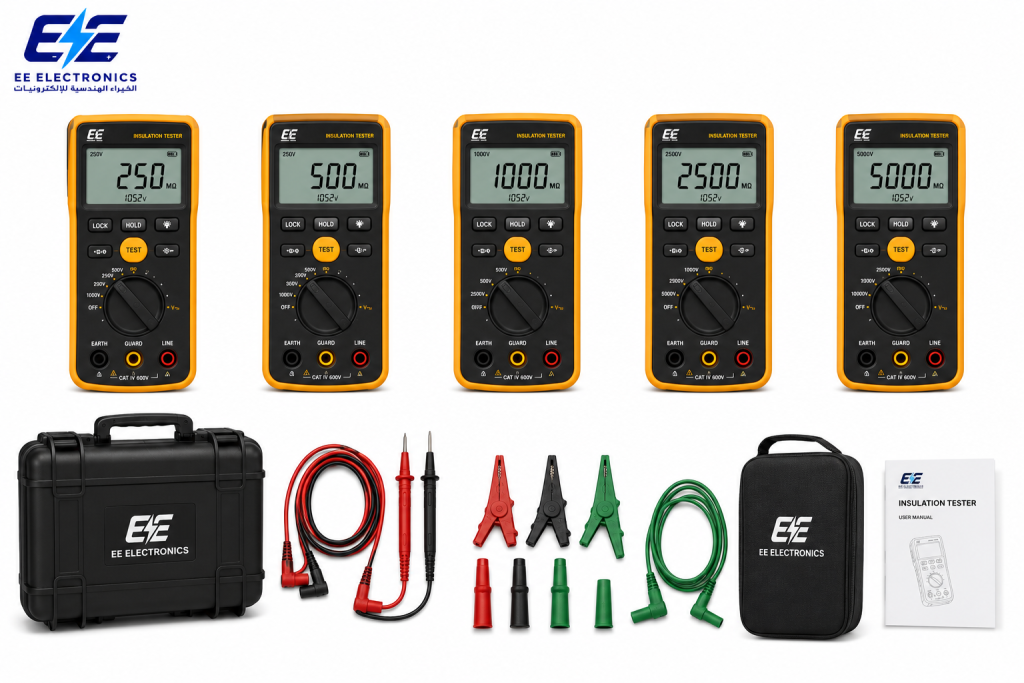
Solar PV testers from EE Electronics
EE Electronics has supplied test and measurement equipment in Jordan for more than 30 years, from its office in Khalda, Amman. Our solar PV testing equipment range covers every step of the PV system life, from installation to O&M, with instruments from brands such as Fluke, Seaward, HT Instruments, Metrel and Sonel. See all the brands we supply.
- The right class of instrument: 1000 V or 1500 V, with or without I-V curve, matched to your systems and modules.
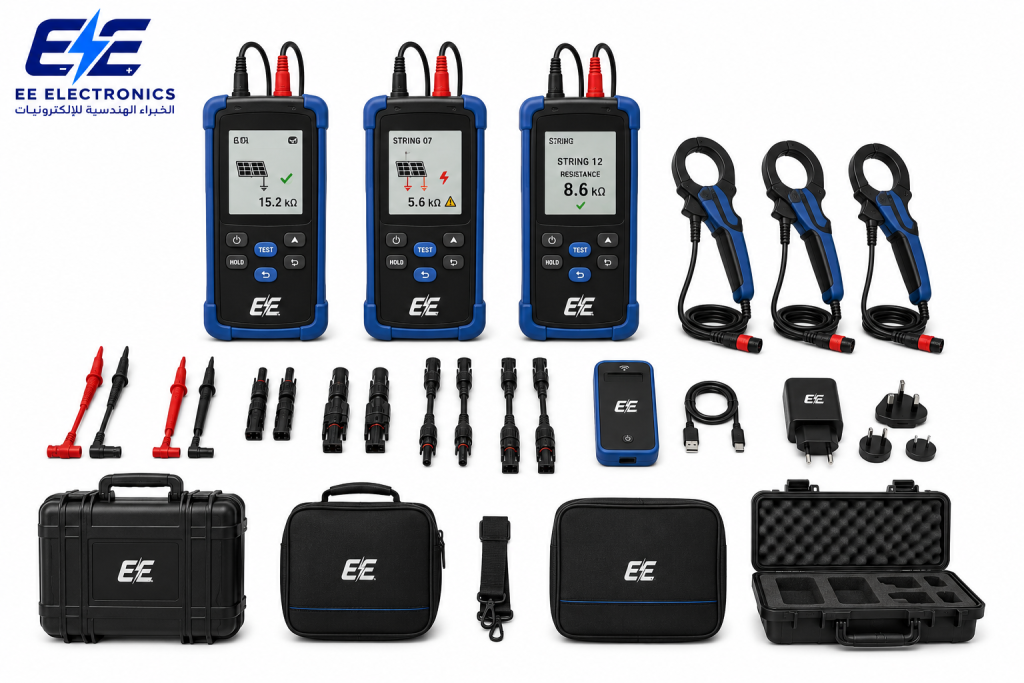
- Complete IEC 62446-1 kits: PV tester, I-V tracer, irradiance meter, clamp meter, thermal camera and EL system from one supplier.
- Fault-finding tools for O&M, including ground fault locators and string monitoring and diagnostic equipment.
- Calibration certificate with every instrument, and local support from Amman.
- Training through our electrical testing and commissioning training.

- Voc, Isc, insulation, continuity and polarity in one sequence
- 1000 V and 1500 V models, with or without I-V curve
- Reporting software for IEC 62446-1 commissioning
Solar PV test equipment in Jordan
Everything needed for IEC 62446-1 commissioning and PV O&M, from EE Electronics in Amman.

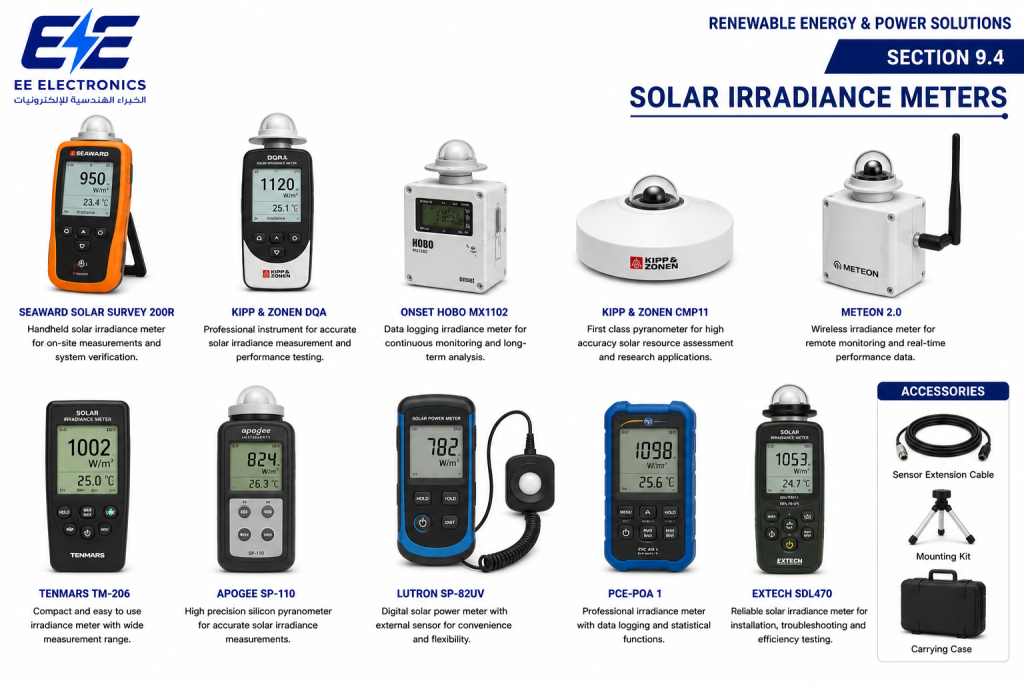
Irradiance and module temperature.

Browse by category
 Solar PV Testing EquipmentPV testers, IV curve tracers, irradiance meters
 Electrical & Electronic EquipmentInsulation, earth, clamp and installation testers
 MV/HV Test EquipmentTransformer and MV cable testing for PV plants
 Safety & Protection EquipmentInsulating gloves, PPE, LOTO
 Measurement & CalibrationElectrical, process and temperature calibrators
 Training & Engineering SolutionsTesting, calibration and safety training
Frequently asked questions
What does a solar PV tester measure?
A solar PV tester measures the IEC 62446-1 Category 1 tests on the DC side of a PV system: protective earth continuity, polarity, string open-circuit voltage, short-circuit or operational current and insulation resistance. Many models also trace the I-V curve.
Do I need an I-V curve tracer or is a PV tester enough?
For residential systems, a multifunction PV tester is usually enough. For commercial, industrial and utility systems, an I-V curve tracer is needed for the IEC 62446-1 Category 2 test and to find performance problems such as shading, soiling, mismatch and degradation.
What insulation test voltage is used for PV arrays?
Under IEC 62446-1, 500 V DC for systems of 120 to 500 V, 1000 V DC for 500 to 1000 V and 1500 V DC for systems above 1000 V, with a minimum insulation resistance of 1 MΩ.
Can I use a 1000 V PV tester on a 1500 V solar plant?
No. The tester and its leads must be rated for the highest voltage they will see, including the cold-morning open-circuit voltage. 1500 V plants need 1500 V-rated instruments.
What irradiance is needed for I-V curve testing?
Stable irradiance of at least 400 W/m² is recommended for string measurements, and at least 700 W/m² (IEC 61829) when results are converted to standard test conditions.
Why does my I-V tracer give poor results on new modules?
Check the instrument’s module efficiency limit. Some tracers specify STC translation only for modules up to about 19% efficiency, and many modern modules exceed that.
How does dust affect PV test results in Jordan?
Soiling reduces the current and power of a string, so I-V results can look like degradation. Record when the modules were last cleaned, or test a few strings before and after cleaning to measure the soiling loss.
Which brands of solar PV tester are available in Jordan?
EE Electronics supplies solar PV testers and I-V curve tracers from brands such as Fluke, Seaward, HT Instruments, Metrel and Sonel, with calibration certificates and local support.
Where can I buy a solar PV tester in Jordan?
EE Electronics supplies solar PV testers, I-V curve tracers, irradiance meters and complete IEC 62446-1 test kits from its office in Khalda, Amman. Send your system details for a quotation within 24 hours.
Buying a solar PV tester in Jordan? Start here.
Tell EE Electronics your system voltages, module types and the tests you need. We will recommend the right solar PV tester or complete kit and reply with a quotation within 24 hours.