Test voltage, measurement range, PI and DAR, safety rating and data logging. The EE Electronics guide to what actually matters when you buy an insulation tester in Jordan, for LV installations, motors, cables and MV assets.
In this guide
Key takeaways
- Choose the test voltage from the rated voltage of the equipment you test. Every other spec follows from it.
- A 1 kV handheld covers LV installations, panels and motors below 1 kV. MV cables, motors, generators and transformers need a 5, 10 or 15 kV diagnostic tester.
- PI, DAR and step-voltage tests are only useful if the tester holds a stable voltage for 10 minutes or more and logs the readings.
- Check the measurement range, the CAT safety rating and the noise rejection before you compare prices.
An insulation resistance (IR) test is the fastest way to know whether a cable, motor, transformer or switchboard is safe to energise. The tester applies a stable DC voltage between a conductor and earth, measures the tiny leakage current, and reports the result in megohms (MΩ), gigohms (GΩ) or teraohms (TΩ).
The market is full of insulation testers that look similar on paper but suit very different jobs. A tester that is perfect for a building electrician will tell an MV maintenance engineer almost nothing, and a 15 kV diagnostic set is an expensive way to check a lighting circuit. This guide from EE Electronics, a test and measurement supplier based in Amman, walks through the five decisions that matter, in the order you should make them.
Step 1: Match the test voltage to the equipment
The test voltage is the first filter. Too low, and weak insulation passes because it is never stressed. Too high, and you risk damaging insulation that was never designed for that stress. Two references cover most of what our customers test.
LV installations (IEC 60364-6)
For building wiring, distribution boards and final circuits, IEC 60364-6 sets the test voltage and the minimum acceptable insulation resistance:
| Circuit nominal voltage | DC test voltage | Minimum insulation resistance |
|---|---|---|
| SELV and PELV | 250 V | 0.5 MΩ |
| Up to 500 V (incl. 230/400 V) | 500 V | 1.0 MΩ |
| Above 500 V | 1,000 V | 1.0 MΩ |
These are minimums for acceptance. A new installation in good condition usually reads hundreds of megohms, so a reading near the limit is a reason to investigate, not a pass to celebrate.
Motors, generators and other windings (IEEE 43)
For rotating machines, IEEE 43 is the reference most maintenance teams follow. NETA uses the same values in its acceptance and maintenance testing tables:
| Winding rated voltage | DC test voltage | Tester class you need |
|---|---|---|
| Below 1,000 V | 500 V | 1 kV handheld |
| 1,000 – 2,500 V | 500 – 1,000 V | 1 kV handheld or 5 kV |
| 2,501 – 5,000 V | 1,000 – 2,500 V | 5 kV diagnostic |
| 5,001 – 12,000 V | 2,500 – 5,000 V | 5 kV diagnostic |
| Above 12,000 V | 5,000 – 10,000 V | 10 kV or 15 kV diagnostic |
The same reference gives minimum one-minute readings, corrected to 40 °C: 100 MΩ for most form-wound AC stators built after 1970, 5 MΩ for random-wound and form-wound coils below 1 kV, and the older “kV + 1” MΩ rule for pre-1970 windings and field windings.
Look at every asset you test, not just the most common one. If your plant has 400 V motors and an 11 kV transformer, a single 5 kV or 10 kV diagnostic tester can cover both, because these units also offer 500 V and 1,000 V ranges.
Step 2: Check the measurement range and accuracy
Healthy MV insulation reads in the tens or hundreds of gigohms, and new cables can go higher still. A handheld tester that tops out at a few GΩ will show “over range” and give you nothing to trend. That is fine for an installation test, but it is useless for predictive maintenance on a transformer.
Instruments built to IEC 61557-2 meet defined requirements for insulation resistance measurement, including a stable test voltage under load. For installation work this is the first thing to check on the datasheet. For diagnostic testers, also compare how accuracy holds at the top of the range, where MV readings actually sit.
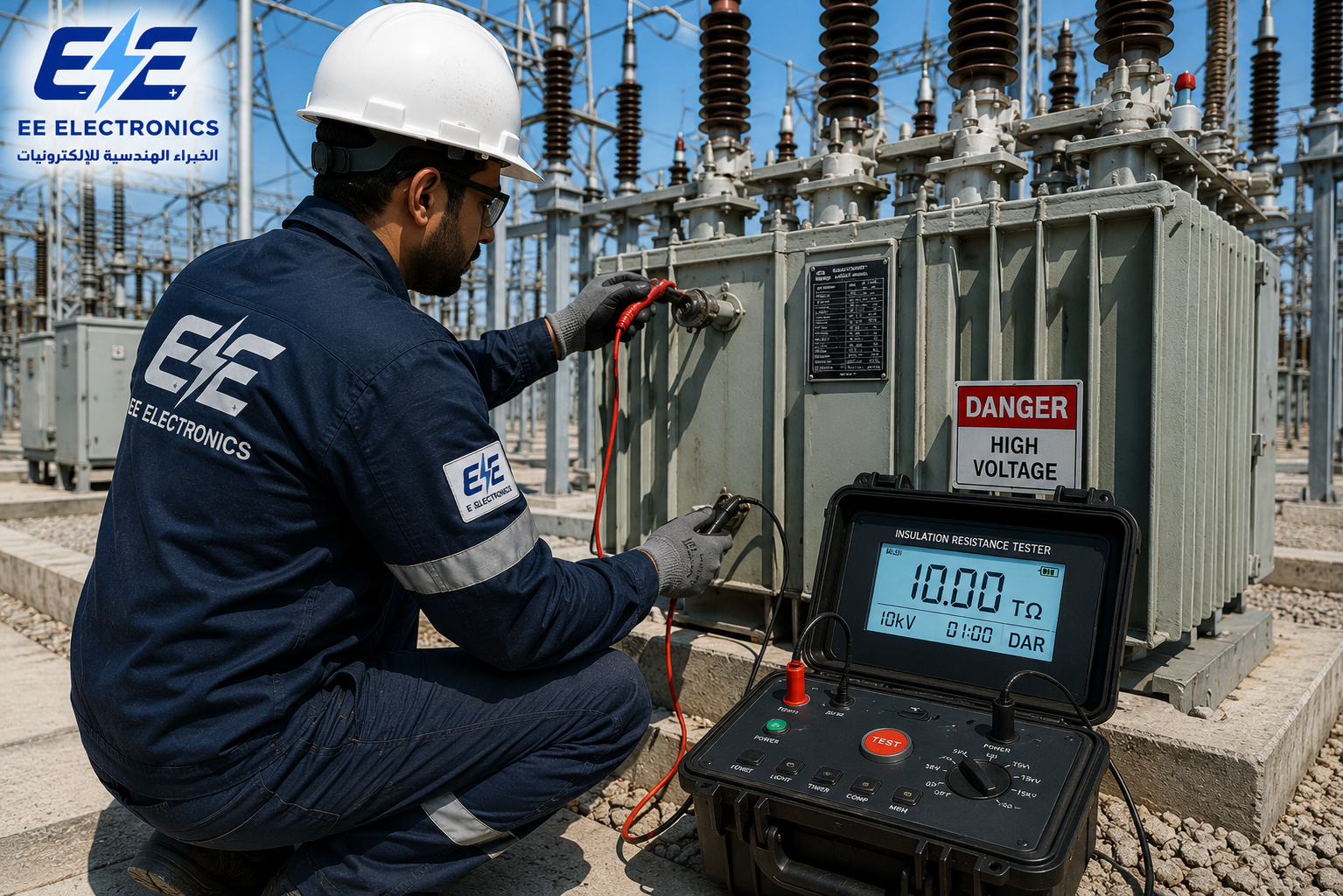
Insulation Resistance Testers (5 kV, 10 kV, 15 kV)
- PI, DAR, step-voltage and dielectric discharge tests
- TΩ measurement range for MV cables and transformers
- Guard terminal, data logging and test reports
Step 3: Decide which diagnostic tests you need
A single one-minute reading tells you the condition today. It is also strongly affected by temperature and humidity, so two readings taken on different days are hard to compare. Diagnostic tests solve that by looking at how the reading changes over time or with voltage.
Polarization Index (PI)
PI divides the 10-minute reading by the 1-minute reading. Clean, dry insulation keeps absorbing charge, so the resistance rises over the ten minutes. Moisture and contamination provide a leakage path, so the reading stays flat. Because PI is a ratio, it largely cancels out the temperature effect.
| PI value | Insulation condition |
|---|---|
| Below 1.0 | Dangerous |
| 1.0 – 2.0 | Questionable |
| 2.0 – 4.0 | Good |
| Above 4.0 | Excellent |
Very high PI values on old, aged insulation can also point to brittleness, so read PI alongside the absolute resistance and the asset’s history.
Dielectric Absorption Ratio (DAR)
DAR is the short version of the same idea: the 60-second reading divided by the 30-second reading. It is quicker on site and useful for smaller equipment, but less reliable than PI on large, high-capacitance assets such as long cables and big generators.
Step voltage (SV) and dielectric discharge (DD)
The step-voltage test raises the voltage in equal steps. Healthy insulation gives roughly the same resistance at each step; a drop at higher voltage points to cracks, voids or surface contamination. Dielectric discharge measures the current as the insulation discharges after the test, which helps find problems in multi-layer insulation such as generator windings. Both are found only on diagnostic testers, usually in the 5 kV class and above.
Record the insulation temperature and the humidity with every test, and save the results against the asset tag. A falling trend over three or four years is a clearer warning than any single pass/fail value.
Not sure which voltage class you need?
Send us the ratings of the equipment you test. Our engineers will recommend a tester and reply with a quote within 24 hours.
Step 4: Check the safety rating and build quality
An insulation tester is connected to circuits that may have been live minutes earlier, so its safety rating matters as much as its accuracy.
- CAT rating under IEC 61010. For work on distribution boards and the origin of an installation, look for CAT IV 600 V or better on the measurement terminals. CAT III 1000 V suits most work downstream of the main board.
- Live circuit warning. A good tester detects voltage on the circuit before the test starts and refuses to run.
- Automatic discharge. Long cables and large windings store a dangerous charge after the test. The tester should discharge the circuit automatically and show the voltage until it is safe.
- Case and leads. For outdoor substations and solar plants, check the IP rating, the operating temperature range and the quality of the test leads and clips.
Isolate, lock out and prove dead before connecting the leads. Even with an automatic discharge feature, short the circuit to earth before you touch it after a test on long cables or large windings.
Step 5: Compare the practical features
Once voltage, range and safety are settled, these features separate a tester you trust from one that stays in the cupboard:
Guard terminal
On dirty or damp bushings and cable terminations, current leaks across the surface and drags the reading down. The guard terminal diverts that surface current away from the measurement, so you see the condition of the insulation itself. It is standard on diagnostic testers and worth having on any tester used for MV work.
Noise rejection
In energised substations, induced current from nearby live equipment can make readings unstable. Diagnostic testers specify how much interference current they reject; for example, current Megger MIT models reject up to 3 mA. If you test in switchyards, compare this figure.
Power, storage and reporting
Check whether the tester runs on rechargeable batteries, mains or both, and how many 10-minute PI tests one charge supports. For maintenance teams, internal memory, USB or Bluetooth download and reporting software turn readings into a trend you can show to an auditor or a client.
Handheld, 5 kV or 10–15 kV: which class fits your work?
| 1 kV handheld | 5 kV diagnostic | 10 / 15 kV diagnostic | |
|---|---|---|---|
| Typical users | Electricians, building and panel testing | Industrial maintenance, MV commissioning | Utilities, HV substations, large generators |
| Test voltages | 50 V to 1,000 V | Up to 5,000 V | Up to 10,000 or 15,000 V |
| Range | GΩ | Around 10 TΩ | 20 TΩ and above |
| PI and DAR | Some models | Yes | Yes |
| SV and DD tests | No | Most models | Yes |
| Example models | Megger MIT400 series, Fluke 1500 series | Megger MIT515 / MIT525, Fluke 1550C | Megger MIT1025 / MIT1525, Fluke 1555 |
For most industrial sites in Jordan, with 400 V and 690 V motors plus an MV substation, the 5 kV class is the best balance of cost and capability. Utilities and contractors who commission 33 kV and 132 kV equipment should look at the 10 kV and 15 kV class.
Choosing an insulation tester for Jordan’s networks
Jordan’s power system gives a clear picture of what most local teams test. NEPCO runs the 400 kV and 132 kV transmission grid, while JEPCO, IDECO and EDCO run the 33 kV and 11 kV distribution networks and the 400/230 V supply to homes, factories and commercial buildings. Add the 33 kV collection cables and step-up transformers of the solar plants built across the country, and the typical test list for a Jordanian maintenance or commissioning team looks like this:
- LV installations and panels (400/230 V): a 1 kV handheld tester, testing at 500 V.
- 11 kV cables, switchgear and motors: a 5 kV diagnostic tester.
- 33 kV cables and transformers, including solar plant substations: a 10 kV or 15 kV diagnostic tester, followed by a VLF cable test on new or repaired cables.
Heat and dust matter too. Summer site temperatures in the Jordan Valley, Aqaba and the eastern desert make temperature correction essential when you trend readings, and dust on terminations is exactly where a guard terminal earns its place. EE Electronics supplies insulation testers from Megger, Fluke, Kyoritsu, Hioki and Metrel from its office in Khalda, Amman, with technical guidance before you buy and local support afterwards.
Buyer’s checklist
Before you ask EE Electronics or any supplier for a quote, confirm the tester meets these points for your application. For the rest of your toolkit, see our electrical testing equipment list.
- The test voltages cover every asset class on your site, with adjustable steps.
- The range reaches TΩ levels if you test MV cables, transformers or generators.
- PI, DAR and step-voltage tests run automatically with a timer.
- The safety rating is CAT IV 600 V or better for the terminals you connect to.
- A guard terminal is included for surface leakage on bushings and terminations.
- Results can be stored, exported and turned into a test report.
- Calibration certificates and local service are available after purchase.
How to run a basic insulation resistance test
- Isolate and prove deadSwitch off, lock out and verify absence of voltage. Disconnect sensitive electronics such as drives, surge devices and relays that could be damaged by the test voltage.
- Discharge and connect the leadsEarth the circuit briefly to remove stored charge. Connect the line lead to the conductor and the earth lead to the frame or cable screen. Use the guard lead on the surface you want to exclude.
- Select the voltage and durationChoose the test voltage from the tables above. Run for one minute for a spot reading, or ten minutes for a PI test.
- Record the conditionsNote the reading, the insulation temperature and the humidity, then correct to the reference temperature if you are trending results.
- Discharge before disconnectingLet the tester discharge the circuit and wait until the voltage reads zero before removing the leads.
Need the testing done for you?
Our partner AQ Electric carries out insulation resistance, VLF and full commissioning tests on site. See their testing services in Jordan or their IEC 62446-1 testing guide for solar plants.
Insulation testers from EE Electronics
Supplied with calibration certificates and local support in Jordan.
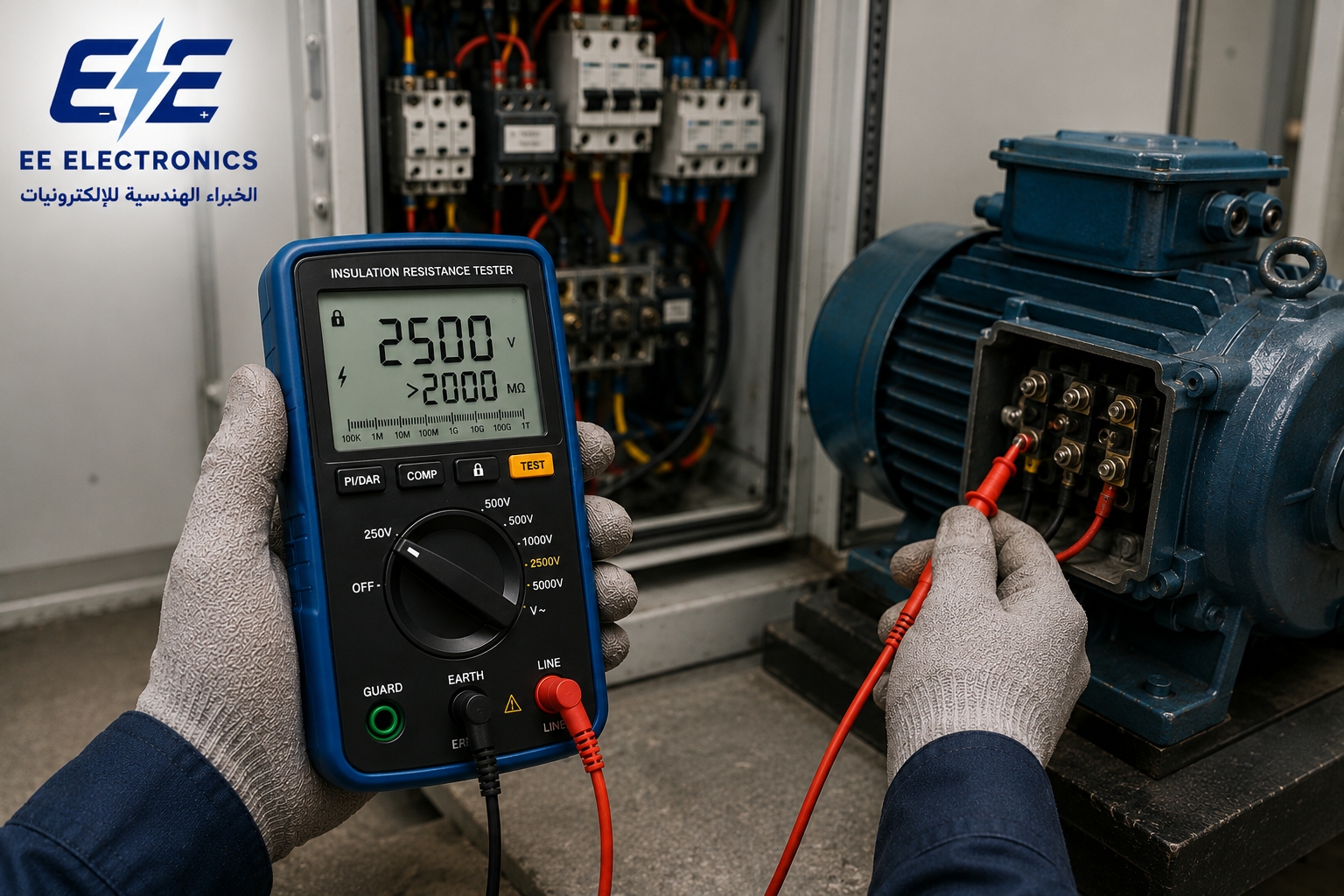
Insulation Resistance Testers (up to 1 kV)
Handheld testers for LV installations, panels and motors.
Insulation Resistance Testers (5–15 kV)
Diagnostic testers with PI, DAR, SV and DD tests.
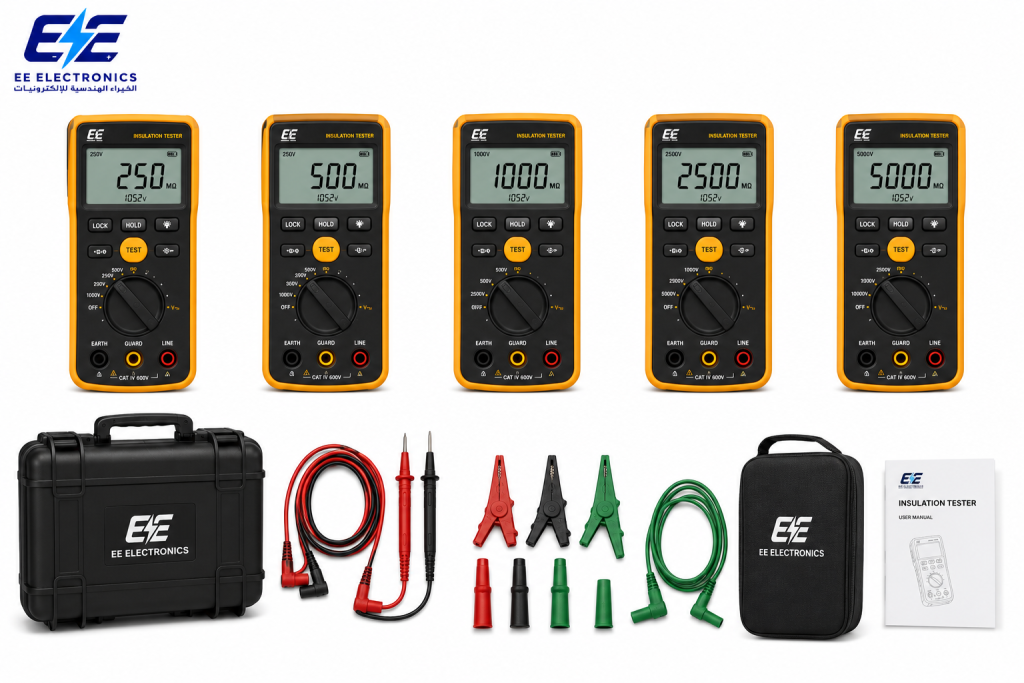
Solar Insulation Resistance Testers
Rated for PV arrays and DC cables in solar plants.
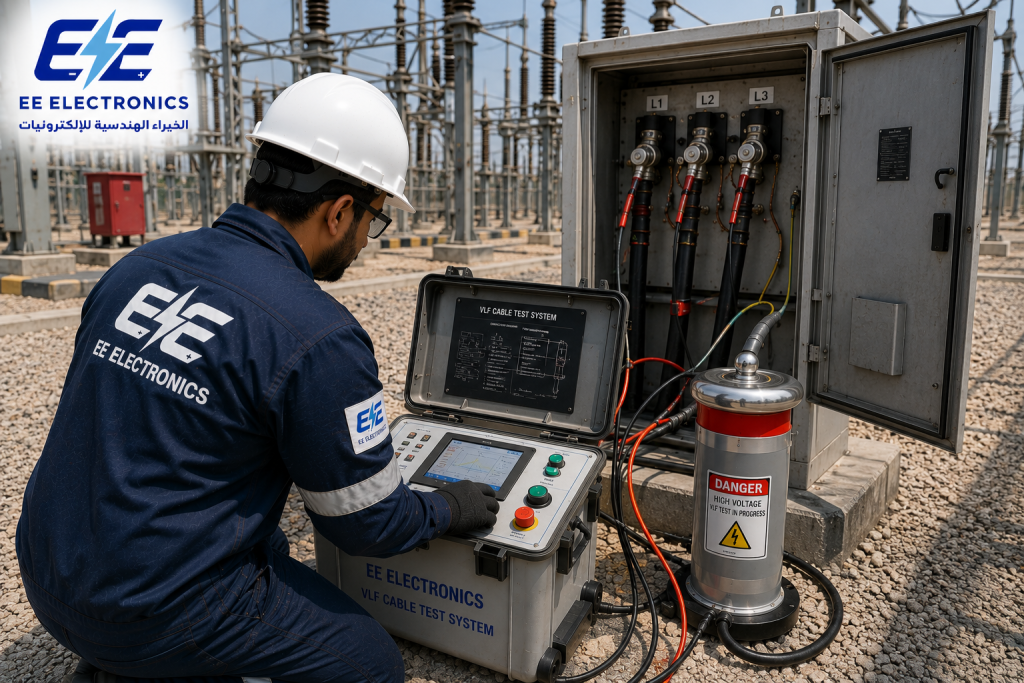
The next step after IR testing for new or repaired MV cables.
Browse related categories




Frequently asked questions
What is a good insulation resistance value?
It depends on the equipment. For LV installations, IEC 60364-6 sets a minimum of 1 MΩ at 500 V or 1,000 V. For most modern form-wound motor windings, IEEE 43 recommends at least 100 MΩ. In practice, healthy equipment reads far above these minimums, so trends over time matter more than a single value.
Is a 1 kV insulation tester enough for an 11 kV cable?
No. A 1 kV test does not stress 11 kV insulation enough to reveal weaknesses, and its range is usually too low to read healthy MV insulation. Use a 5 kV or 10 kV diagnostic tester, and follow with a VLF test after installation or repair.
What is the difference between PI and DAR?
PI divides the 10-minute reading by the 1-minute reading, while DAR divides the 60-second reading by the 30-second reading. DAR is quicker, but PI is more reliable for large motors, generators, transformers and long cables.
Is “Megger” the same as an insulation resistance tester?
Megger is a brand that became so common that many engineers call any insulation tester a “megger” and the test a “megger test”. The correct general name is insulation resistance tester or megohmmeter. Fluke, Kyoritsu, Hioki and Metrel also make insulation testers.
Can I use a standard insulation tester on a solar PV array?
Only if it is rated for the array’s DC voltage and the test method. PV strings stay energised in daylight, so dedicated solar insulation testers and multifunction PV testers are designed to test arrays safely following IEC 62446-1.
How often should an insulation tester be calibrated?
Once a year is standard practice, and sooner if the tester has been dropped or gives unexpected readings. EE Electronics supplies testers with calibration certificates.
Get the right insulation tester, with local support in Jordan
Tell us what you need to test. We will recommend the right model from Megger, Fluke, Kyoritsu, Hioki or Metrel and reply with a quote within 24 hours.