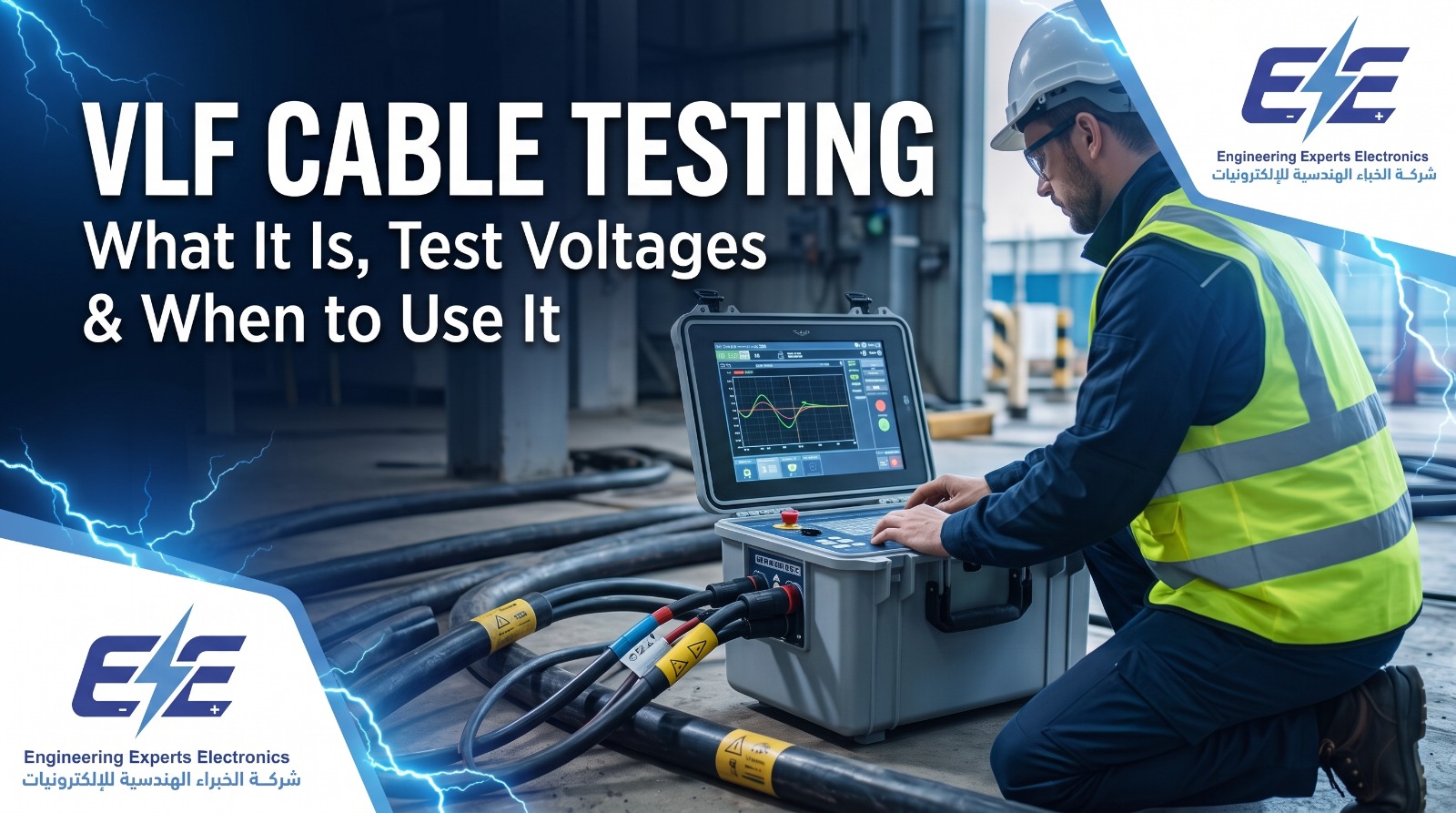
How VLF cable testing works at 0.1 Hz, which test voltage to use for 11 kV and 33 kV cables in Jordan, what tan delta and partial discharge add, and how to choose the right VLF test set. A practical guide from EE Electronics.
In this guide
Key takeaways
- VLF cable testing applies a high AC voltage at about 0.1 Hz. The low frequency cuts the power needed to test a long cable by around 500 times compared with 50 Hz.
- VLF has replaced DC hipot testing on XLPE cables, because high DC voltage can leave trapped charge that damages aged insulation.
- IEEE 400.2 sets the test voltages. For a typical 11 kV cable in Jordan, the acceptance test is 21 kV rms; for a 33 kV cable it is 44 kV rms, applied for 30 minutes.
- Adding tan delta or partial discharge measurement turns a pass/fail withstand test into a condition assessment you can trend.
VLF cable testing is the standard way to prove that a medium voltage cable is fit to energise after installation, after a joint repair, or during planned maintenance. Instead of a DC voltage or a full 50 Hz test, a VLF test set applies an AC voltage at a very low frequency, usually 0.1 Hz, to stress the insulation the way service voltage does, without a truck-sized power source.
For cable contractors, utilities and solar EPCs in Jordan, VLF testing has become a routine line in commissioning specifications for 11 kV and 33 kV cables. This guide from EE Electronics, a test and measurement supplier based in Amman, explains how VLF testing works, the test voltages to use, the diagnostic options that sit on top of it, and what to check before you buy or hire a VLF test set.
What is VLF cable testing?
VLF stands for very low frequency. A VLF test set generates an AC test voltage in the range of 0.01 Hz to 0.1 Hz, with 0.1 Hz used for almost all field tests. The voltage is applied between the cable conductor and its earthed screen, raised to a level above the cable’s normal operating voltage, and held for a set time.
Two waveforms are common: sinusoidal, which most standards and diagnostic measurements are based on, and cosine-rectangular, used by some test sets for long cables. The basic VLF withstand test is a go/no-go check: a healthy cable holds the voltage for the full duration, while a cable with a serious defect breaks down during the test, under controlled conditions, rather than after it is back in service.
An insulation resistance test (often called a megger test) applies a DC voltage of up to 5 to 15 kV and measures resistance. It is a quick screening check, not a withstand test. Most specifications ask for an IR test before and after the VLF test. See our guide on how to choose an insulation resistance tester.
Why VLF instead of DC or 50 Hz testing?
Testing a cable at its own power frequency is the most realistic option, but a cable is a large capacitor. The reactive power needed to charge it rises in direct proportion to frequency, so a 50 Hz test on a few kilometres of 33 kV cable needs heavy resonant test equipment. Dropping the frequency from 50 Hz to 0.1 Hz cuts that power by a factor of 500, which is why a VLF test set fits in a site vehicle.
DC hipot testing solved the power problem in the past, and it is still used on older paper-insulated (PILC) cables. On the XLPE cables that make up almost every new MV network, high DC voltage can build up space charge in the insulation. When the cable goes back into service, that trapped charge can contribute to failures that would not otherwise have happened. IEEE 400 and most utilities now advise against high-voltage DC tests on aged XLPE cable, and VLF has become the default.
| DC hipot | VLF (0.1 Hz) | 50 Hz resonant | |
|---|---|---|---|
| Suitable for XLPE | Not recommended | Yes | Yes |
| Equipment size | Small | Portable | Large, often truck-mounted |
| Tan delta and PD | No | Yes, with the right test set | Yes |
| Typical use | Older PILC cables | MV cables, 5 to 35 kV | HV and EHV cables |
VLF test voltages (IEEE 400.2)
IEEE 400.2 is the reference most specifications use for VLF testing of shielded power cables. It gives three test levels: installation (after laying, before joints and terminations are finished), acceptance (after the cable system is complete, before energising), and maintenance (on cables already in service). All values are phase-to-ground, for a sinusoidal 0.1 Hz waveform.
| Cable rating | Installation | Acceptance | Maintenance |
|---|---|---|---|
| 5 kV | 9 (13) | 10 (14) | 7 (10) |
| 8 kV | 11 (16) | 13 (18) | 10 (14) |
| 15 kV | 19 (27) | 21 (30) | 16 (22) |
| 20 kV | 24 (34) | 26 (37) | 20 (28) |
| 25 kV | 29 (41) | 32 (45) | 24 (34) |
| 28 kV | 32 (45) | 36 (51) | 27 (38) |
| 30 kV | 34 (48) | 38 (54) | 29 (41) |
| 35 kV | 39 (55) | 44 (62) | 33 (47) |
The recommended duration for a VLF withstand test is 30 minutes at 0.1 Hz, and some specifications ask for up to 60 minutes. A cable that holds the voltage for the full time passes.
Which row applies to cables in Jordan?
Jordan’s distribution networks run mainly at 11 kV and 33 kV. In practice, 11 kV XLPE cables (6.35/11 kV) are tested using the 15 kV row, and 33 kV cables (19/33 kV) using the 35 kV row:
Utilities, consultants and solar project owners in Jordan may specify their own test voltage, duration or standard, for example a test based on IEC 60502-2. The project specification always overrides the general values above.
VLF withstand, tan delta and partial discharge tests
The same VLF source can do more than a pass/fail test. Adding a measurement turns VLF cable testing into a diagnostic tool.
VLF withstand test
The basic test described above. It finds serious defects quickly, such as a damaged cable, a poorly made joint or a contaminated termination, but a pass tells you nothing about how close the cable is to failing.
VLF tan delta (dissipation factor)
A tan delta measurement shows how much of the test current is lost in the insulation. Healthy XLPE has very low losses; water trees, moisture in joints and degraded insulation raise them. The test is run in steps, usually at 0.5, 1.0 and 1.5 times the cable’s phase-to-ground voltage (U0), and IEEE 400.2 assesses three values: the mean tan delta, its stability over time, and the “tip-up” between voltage steps. Results are graded as no action required, further study advised, or action required.
VLF partial discharge (PD)
A partial discharge test detects small discharges at weak points, most often in joints and terminations, and can locate them along the cable. It is the most effective way to find a poor accessory before it fails.
Monitored withstand
A monitored withstand test records tan delta or PD continuously during the withstand test. It gives a pass/fail result and a condition reading from the same 30 minutes on site.
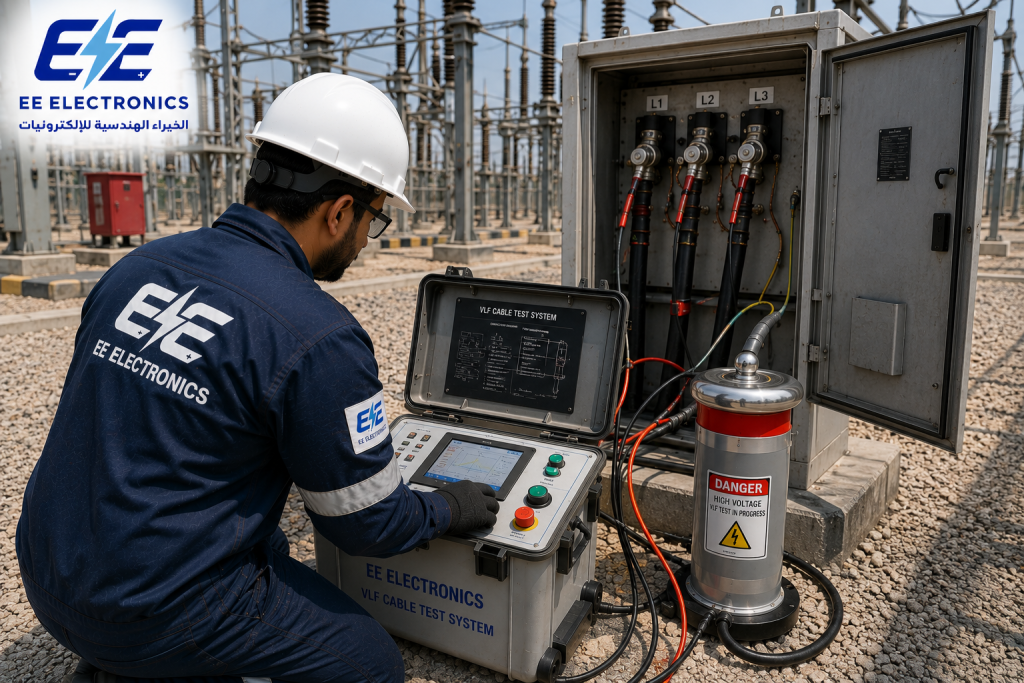
- Sinusoidal 0.1 Hz output for MV cables up to the 35 kV class
- Withstand testing with optional tan delta and PD
- Automatic test sequences and test reports
How a VLF cable test is carried out
- Isolate and earth the cableObtain the permit to work, isolate both ends, prove dead with a high voltage detector and apply portable earths.
- Prepare both endsDisconnect surge arresters, voltage transformers and any equipment that should not see the test voltage. Clean the terminations and set up barriers and warning signs at the far end.
- Run an insulation resistance testTest each phase with an insulation tester. A very low reading points to a fault that should be found before the VLF test.
- Connect the VLF test setConnect the high voltage lead to the conductor of the phase under test, with the screen and the other phases earthed.
- Ramp, hold and monitorRaise the voltage to the specified level and hold it for the specified time, usually 30 minutes, while monitoring current, tan delta or PD if measured.
- Discharge, earth and reportLet the test set discharge the cable, apply earths, repeat the IR test and record the results for each phase.
A long cable stores a large charge after any high voltage test. Keep it earthed with proper grounding and earthing equipment until it is reconnected, and never rely on time alone to discharge it.
Testing 11 kV or 33 kV cables in Jordan?
Tell EE Electronics your cable voltage and longest cable length. We will recommend the right VLF test set and reply with a quote within 24 hours.
VLF cable testing in Jordan
Jordan’s grid has a simple structure. NEPCO operates the 400 kV and 132 kV transmission network, and three distribution companies, JEPCO, IDECO and EDCO, run the 33 kV and 11 kV networks that feed cities, industry and rural areas. As in most countries, new MV cable in Jordan is almost always XLPE, which is why VLF testing is the method most commissioning specifications now call for.
These are the projects where EE Electronics customers in Jordan use VLF testing most often:
- Solar and wind plants: 33 kV collection cables between inverter stations and the plant substation, tested at acceptance before the plant is energised.
- Utility network works: new 11 kV and 33 kV feeders, and cables after a joint or termination has been repaired.
- Industrial plants and large buildings: 11 kV feeders to factories, hospitals, malls and data centres in Amman, Zarqa, Irbid and Aqaba.
- Maintenance programmes: tan delta testing to decide which older cables to replace first.
Summer heat matters for the equipment as well as the cable. A VLF test set used on solar sites in the eastern desert or the Jordan Valley needs a wide operating temperature range and should be protected from direct sun between tests.
How to choose a VLF test set
If you are equipping a full MV testing team, start with the MV section of our electrical testing equipment list. Choosing a VLF test set itself comes down to two numbers: the highest test voltage you need, and the largest cable capacitance (in practice, the longest cable) you need to test at that voltage.
- The peak output covers your highest test level. For 33 kV cables at acceptance, that means at least 62 kV peak; for 11 kV cables, at least 30 kV peak.
- The test set can charge your longest cable at full voltage. Check the maximum load in µF at 0.1 Hz; many sets can test longer cables by reducing the frequency.
- The output is sinusoidal if you plan to measure tan delta.
- Tan delta and PD are built in or can be added later as modules.
- Weight, size and power supply suit how you reach site, including solar plants far from a main road.
- Test reports can be exported for the client and the utility.
Need cables tested for you?
Our testing partner AQ Electric carries out VLF, tan delta and full MV commissioning tests on site. See their testing services in Jordan.
MV cable test equipment from EE Electronics
Supplied with technical guidance and local support from our Amman office.

Tan Delta / Dissipation Factor Testers
Insulation loss measurement for cables, transformers and bushings.


Pinpoint the fault when a cable fails its VLF test.
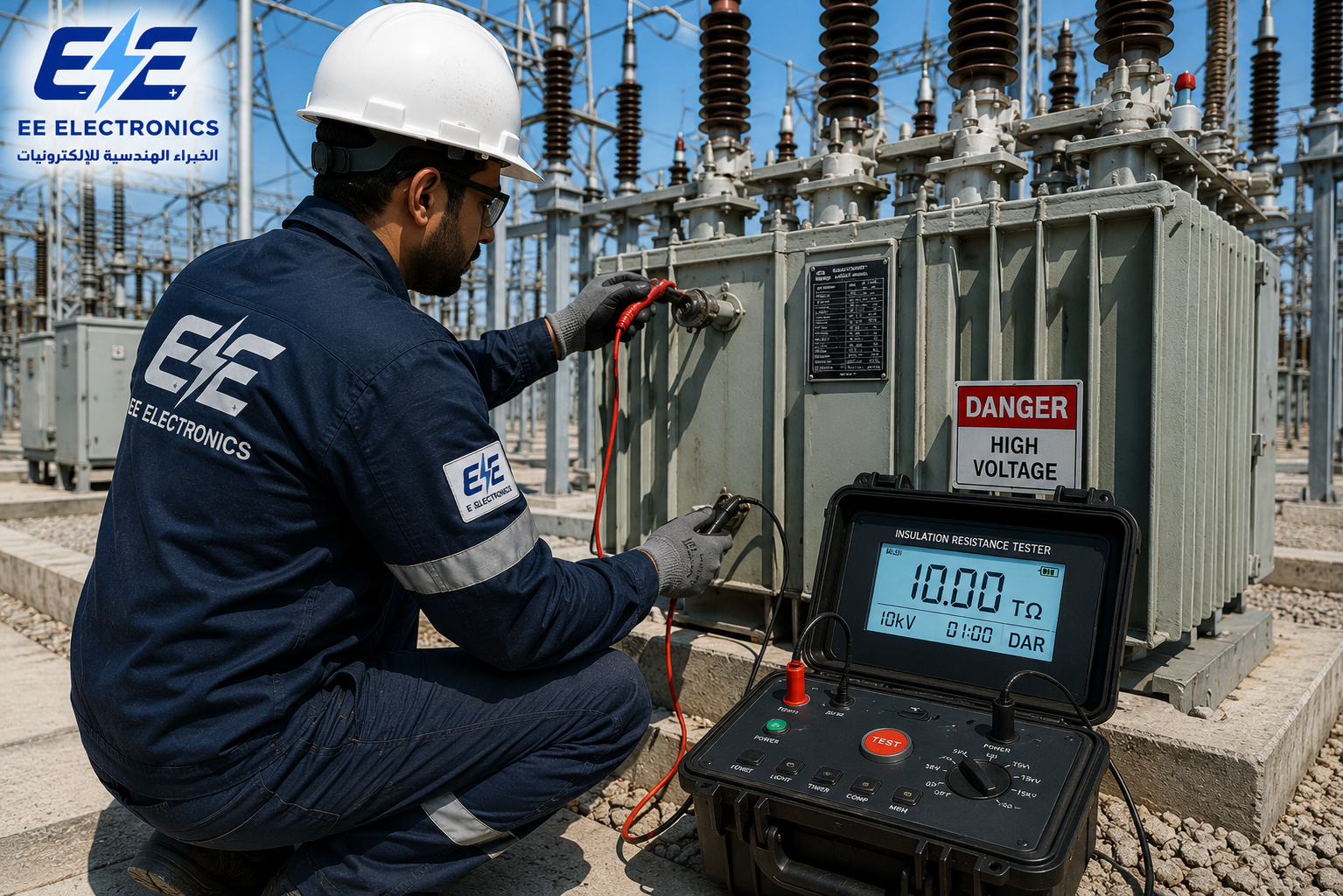
Insulation Resistance Testers (5–15 kV)
The IR test before and after every VLF test.
Browse related categories



Frequently asked questions
What is VLF cable testing?
VLF cable testing applies an AC voltage at a very low frequency, usually 0.1 Hz, to a medium voltage cable to prove its insulation can withstand a voltage above its normal operating level. It is the standard test for XLPE cables after installation, after repairs and during maintenance.
What VLF test voltage is used for an 11 kV cable?
Under IEEE 400.2, an 11 kV cable is tested using the 15 kV class values: 19 kV rms at installation, 21 kV rms at acceptance and 16 kV rms for maintenance, usually for 30 minutes at 0.1 Hz. Always check the project specification first.
What VLF test voltage is used for a 33 kV cable?
A 33 kV cable is tested using the 35 kV class values in IEEE 400.2: 39 kV rms at installation, 44 kV rms (62 kV peak) at acceptance and 33 kV rms for maintenance. The test set must deliver at least 62 kV peak for an acceptance test.
Is VLF testing destructive?
Not for healthy cable. VLF voltage stresses the insulation in a similar way to service voltage, so a sound cable passes without damage. A cable with a serious defect may fail during the test, which is the purpose: it fails under controlled conditions instead of after energising.
What is the difference between VLF testing and a megger test?
A megger test is an insulation resistance test that applies a DC voltage and measures resistance. A VLF test applies a higher AC voltage for 30 minutes or more to prove the cable can withstand it. They complement each other, and most specifications require an insulation resistance test before and after the VLF test.
Where can I buy a VLF test set in Jordan?
EE Electronics supplies VLF cable test systems, tan delta and partial discharge testers from its office in Khalda, Amman, with technical guidance on choosing the right voltage class and local support after purchase. Contact the team for a quote within 24 hours.
Get the right VLF test set, with local support in Jordan
Tell EE Electronics the cable voltages and lengths you test. We will recommend the right VLF system, with tan delta or PD if you need it, and reply with a quote within 24 hours.