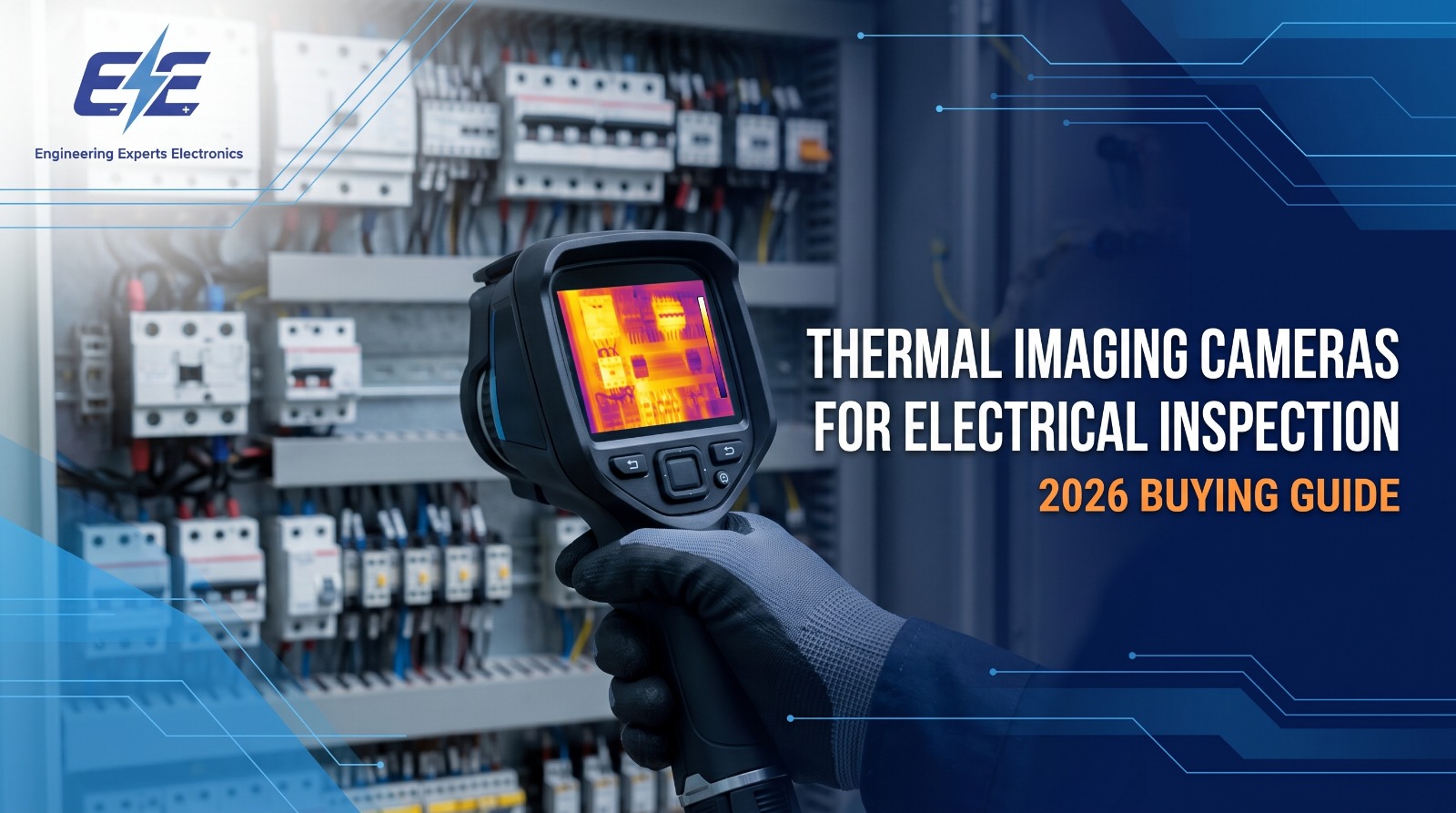
Resolution, thermal sensitivity, spot size, temperature range and reporting: what matters when you buy a thermal imaging camera for electrical inspection, how to read the results, and how to plan inspections around Jordan’s summer peak. A practical guide from EE Electronics.
In this guide
Key takeaways
- For electrical inspection, choose a radiometric camera with at least 160×120 pixels for panels at close range, and 320×240 or more for switchgear, overhead lines and substations.
- Spatial resolution (IFOV) decides how small a connection you can measure from a safe distance. It matters more than the pixel count printed on the box.
- A hot spot only means something under load. Scan at 40% of normal load or more, ideally at peak, and compare similar phases.
- NFPA 70B (2023) now requires electrical equipment to be inspected at least every 12 months, which makes a thermal camera a core maintenance tool rather than an extra.
A thermal imaging camera for electrical inspection lets you see a problem before it becomes an outage, a fire or an arc flash. Loose connections, overloaded conductors, failing breakers and unbalanced phases all produce heat, and a thermal camera turns that heat into a picture you can measure, record and act on, while the equipment stays in service.
The challenge is choosing the right camera. Prices range from a few hundred dollars to tens of thousands, and the spec sheets are full of numbers that are easy to compare and hard to interpret. This buying guide from EE Electronics, a test and measurement supplier based in Amman, explains which specifications matter for electrical work, how to interpret what the camera shows, how to run an inspection, and what to consider for the conditions maintenance teams face in Jordan.
What a thermal imaging camera finds in electrical systems
Current flowing through resistance produces heat. When a connection loosens, corrodes or is undersized, its resistance rises and it runs hotter than the parts around it. A thermal imaging camera shows that difference instantly, which is why infrared thermography has become the standard first step in electrical maintenance.
- Loose or corroded connections on busbars, cable lugs, breaker terminals and fuse holders, the most common finding in any panel.
- Overloaded conductors and circuits that run hot along their full length, not only at the terminations.
- Phase imbalance, where one phase runs noticeably hotter or cooler than the other two.
- Failing breakers, contactors and fuses with internal contact problems.
- Harmonic heating on neutral conductors and transformers feeding drives, UPS systems and LED lighting.
- Transformer problems, such as blocked cooling fins, low oil level or hot bushings.
- Motor and bearing problems on the mechanical side of the same plant.
A hot spot tells you where to look. Confirm the cause with the right instrument: a clamp meter for load and imbalance, a power quality analyzer for harmonics, and an insulation tester for insulation problems.
The specifications that matter for electrical work
Six specifications decide whether a thermal imaging camera for electrical inspection will do the job. Compare them in this order.
1. Detector resolution
Resolution is the number of temperature measurement points in each image. A 160×120 detector measures 19,200 points; a 320×240 detector measures 76,800, four times as many; a 640×480 detector measures over 300,000. More pixels mean sharper images, smaller targets measured accurately, and a greater safe working distance from live equipment.
- Around 120×90 to 160×120: close-range work on LV panels, distribution boards and motors.
- 320×240: the most popular choice for professional electrical maintenance, including MCCs, switchgear and transformers.
- 640×480 and above: substations, overhead lines, large solar plants and anything you must inspect from several metres away.
2. Spatial resolution (IFOV) and spot size
IFOV (instantaneous field of view), given in milliradians (mrad), tells you how much area one pixel covers at a given distance. Multiply the IFOV by the distance in metres to get the size of one pixel’s spot in millimetres. For a reliable temperature reading, the target should fill at least 3×3 pixels.
| Detector | IFOV (approx.) | At 1 m | At 3 m | At 10 m |
|---|---|---|---|---|
| 160×120 | 2.7 mrad | 8 mm | 25 mm | 82 mm |
| 320×240 | 1.3 mrad | 4 mm | 12 mm | 39 mm |
| 640×480 | 0.65 mrad | 2 mm | 6 mm | 20 mm |
The table shows why resolution matters in substations. From 10 m, an entry-level camera cannot accurately measure a single bolted connection, while a 640×480 camera can. A telephoto lens has the same effect as more pixels for distant targets.
3. Thermal sensitivity (NETD)
NETD (noise equivalent temperature difference) is the smallest temperature difference the camera can show, given in millikelvin (mK). Lower is better. Around 50 to 60 mK is fine for most electrical inspection, where the faults you are looking for are several degrees above normal. Below 40 mK gives cleaner images of small temperature differences, which helps with early-stage faults, building inspection and solar modules.
4. Temperature range and accuracy
A range of about −20 °C to 400 °C covers most electrical work; some cameras extend to 650 °C or more for industrial processes. Typical accuracy is ±2 °C or ±2% of reading. For electrical inspection, consistency between readings matters more than absolute accuracy, because you compare one phase with another.
5. Radiometric images and reporting
A radiometric camera stores a temperature value for every pixel, so you can analyse the image later on a computer, adjust emissivity and produce a report. Without radiometric images you cannot defend a finding to a client, an insurer or an auditor. Look for image fusion (a visible image blended with the thermal image), voice or text notes, and reporting software that suits your team.
6. Build quality and operating temperature
Check the IP rating (IP54 or better for outdoor sites), the drop rating and, important in Jordan, the maximum operating temperature. A camera rated to 40 °C may shut down on a summer afternoon on a solar plant or a rooftop substation.

- Compact, handheld and high-resolution industrial models
- Radiometric images, image fusion and laser targeting
- Wireless reporting and interchangeable lenses on advanced models
Entry-level, professional or advanced: which class fits your work?
| Entry-level | Professional | Advanced | |
|---|---|---|---|
| Resolution | Around 120×90 to 160×120 | Around 320×240 | 464×348 to 640×480 and above |
| Typical NETD | About 60–100 mK | About 40–50 mK | About 30 mK or lower |
| Lenses | Fixed | Fixed or optional | Interchangeable, incl. telephoto |
| Best for | Electricians, LV panels, HVAC | Plant maintenance, MCCs, switchgear | Substations, utilities, large solar plants |
| Example models | FLIR E5 Pro, Testo 868 | FLIR E8 Pro, Testo 872 | FLIR T540 / T860, Fluke Ti480 PRO |
For most industrial and commercial maintenance teams in Jordan, the professional class is the best balance of price and capability. If you inspect 33 kV and 132 kV substations, overhead lines or large solar fields, go straight to the advanced class, or add a telephoto lens.
How to read the results: temperature criteria
A thermal image is only useful if you can decide what to do about it. The most widely used guidance for electrical equipment is the thermographic criteria in the NETA maintenance testing specifications, which compare a component with similar components under similar load, or with the ambient air.
| Above similar components | Above ambient air | Suggested action |
|---|---|---|
| 1–3 °C | 1–10 °C | Possible deficiency Investigate |
| 4–15 °C | 11–20 °C | Probable deficiency Repair as time permits |
| — | 21–40 °C | Deficiency Monitor until repaired |
| Over 15 °C | Over 40 °C | Major discrepancy Repair immediately |
Comparing similar components is usually more reliable than comparing with ambient, especially outdoors in summer. Three identical breakers on the same load should show almost the same temperature; if one is 20 °C hotter, it needs attention whatever the ambient.
Bare copper, aluminium and polished busbars have low emissivity and reflect the heat around them, so the camera reads them wrongly. Measure on insulation, painted or oxidised surfaces, or on a piece of electrical tape, and set the emissivity and reflected temperature in the camera.
Not sure which resolution you need?
Tell EE Electronics what you inspect and from what distance. We will recommend a thermal camera and reply with a quote within 24 hours.
How to run an electrical thermography inspection
- Plan the route and the timingList the panels, switchgear, transformers and motors to inspect, and schedule the inspection when the load is high. Most thermography guidance asks for at least 40% of normal load; peak load is better.
- Prepare for live workOpening covers on energised equipment is an arc flash risk. Follow your site’s live-work procedure and wear rated arc flash protection. Infrared windows let you inspect switchgear without opening the panel.
- Set up the cameraEnter the emissivity and reflected temperature, check the focus, and set a temperature range that suits the target.
- Scan, then measureScan each panel from top to bottom, then place spot or box measurements on hot spots and on the matching points of the other phases.
- Record the conditionsNote the load current with a clamp meter, the ambient temperature and the wind speed outdoors, because all three change the temperature you see.
- Report and re-scanRank findings by severity, issue the report, and re-scan after repairs to confirm the problem is gone.
Infrared radiation does not pass through panel doors, glass or plastic covers. To inspect inside, the panel must be opened by a qualified person in the right PPE, or fitted with infrared windows.
How often should electrical equipment be inspected?
The 2023 edition of NFPA 70B turned a long-standing recommended practice into a standard. It requires electrical equipment to be inspected at least every 12 months, and equipment in poor condition (Condition 3 under the standard) to have a thermographic inspection at least every 6 months. NFPA 70B is a US standard, but many multinational companies, insurers and international consultants working in Jordan use it as their reference.
In practice, most industrial sites run an annual thermography survey, with more frequent scans on critical equipment such as main switchboards, transformers, UPS systems and production-critical motor control centres.
Thermal imaging for electrical inspection in Jordan
Jordan’s climate and load profile make a thermal imaging camera for electrical inspection especially valuable, and also change how you should plan the work.
- Summer peak load: air conditioning drives the highest electrical loads of the year in July and August. Connections that are fine in winter can overheat in summer, so the most useful survey is a few weeks before the summer peak, with a follow-up scan during it.
- High ambient temperatures: outdoor panels, rooftop equipment and substations in Amman, the Jordan Valley, Aqaba and the eastern desert can sit well above 40 °C in the sun. Compare similar components rather than relying on rise over ambient, and check the camera’s operating temperature.
- Dust: dust on insulators, terminations and cooling fins raises temperatures and changes emissivity. Note dusty equipment in the report and clean it as part of the corrective action.
- Solar plants: thermography is a standard check on PV modules, combiner boxes, inverters and 33 kV substations across Jordan’s solar fleet. Dedicated thermal cameras for solar inspection and drone-mounted cameras make large plants practical to survey.
- Industry and buildings: factories in industrial cities such as Sahab, Zarqa and Aqaba, hospitals, malls, hotels and data centres in Amman all rely on main switchboards and MCCs that benefit from annual thermography.
EE Electronics supplies thermal imaging cameras from FLIR, Fluke, Testo and other leading manufacturers from its office in Khalda, Amman, with help choosing the right resolution and lens before you buy, and local support afterwards. For teams new to thermography, EE Electronics also offers electrical testing and commissioning training.
Thermal camera or infrared thermometer?
An infrared thermometer measures one spot. A thermal camera measures thousands at once. Both have a place in an electrical toolkit.
| Infrared thermometer | Thermal imaging camera | |
|---|---|---|
| Measures | One spot at a time | Thousands of points per image |
| Finds unknown hot spots | Only if you aim at them | Yes, at a glance |
| Records evidence | A number | A radiometric image for the report |
| Best for | Quick checks on known points | Surveys, reporting and trending |
Buyer’s checklist
Before you ask EE Electronics or any supplier for a quote, confirm the thermal imaging camera for electrical inspection you are considering meets these points. The rest of a maintenance toolkit is in our electrical testing equipment list.
- The resolution and IFOV let you measure your smallest target from your normal working distance.
- The camera stores fully radiometric images, with emissivity and reflected temperature adjustable afterwards.
- The temperature range covers your equipment, and the operating temperature suits summer conditions on site.
- Image fusion, a laser pointer and on-image notes make findings easy to locate later.
- The reporting software produces reports your client or insurer will accept.
- Optional lenses are available if you will inspect substations or overhead lines.
- Calibration, battery replacement and local support are available in Jordan.
Need a thermography survey done for you?
Our testing partner AQ Electric carries out thermographic inspections of solar plants and electrical installations. Read their guide to infrared thermography for solar PV or see their testing services in Jordan.
Thermal and diagnostic tools from EE Electronics
Supplied with technical guidance and local support from our Amman office.

Thermal Imaging Cameras for Solar
High-resolution and drone-compatible cameras for PV plants.
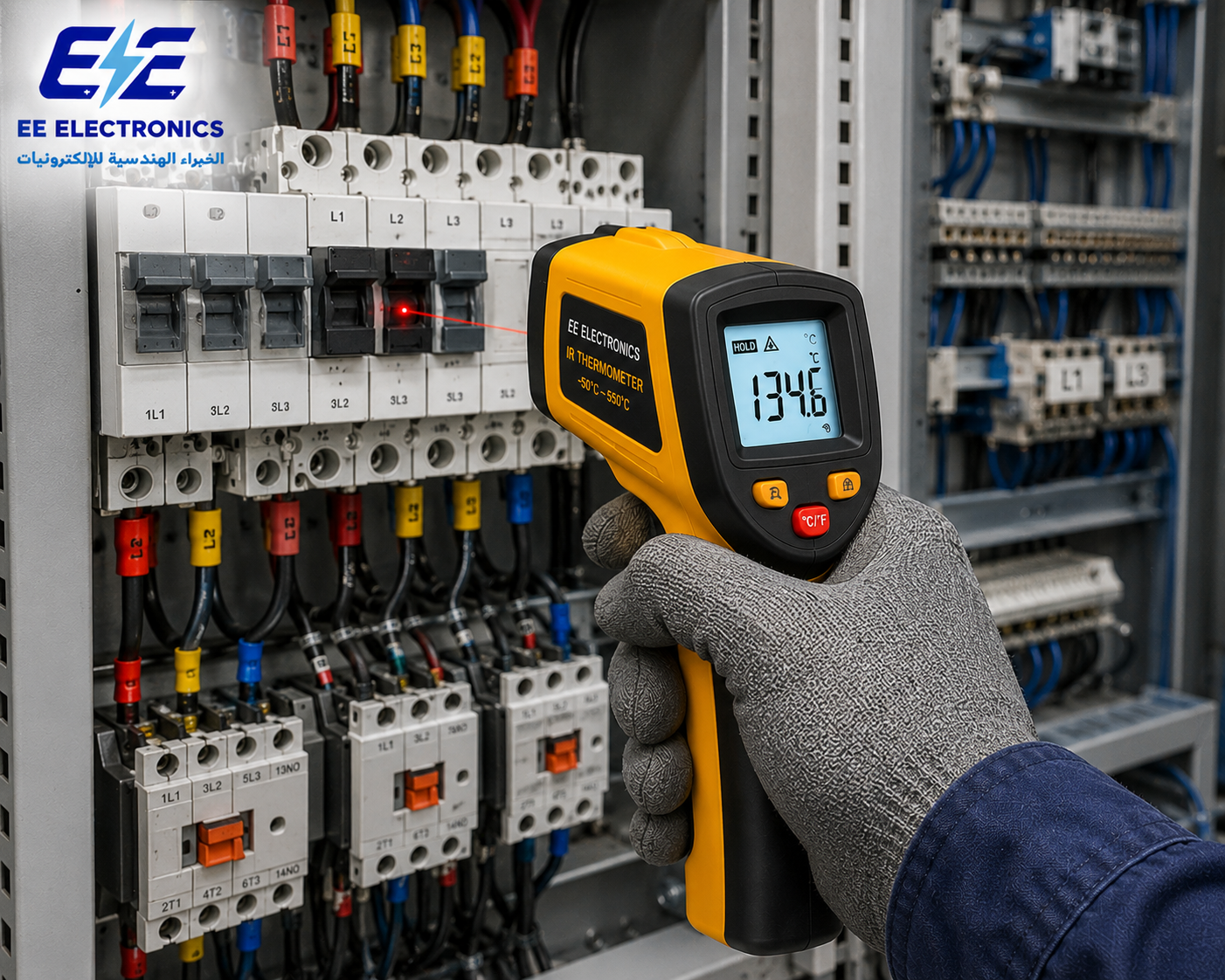
Quick spot checks on known points between surveys.
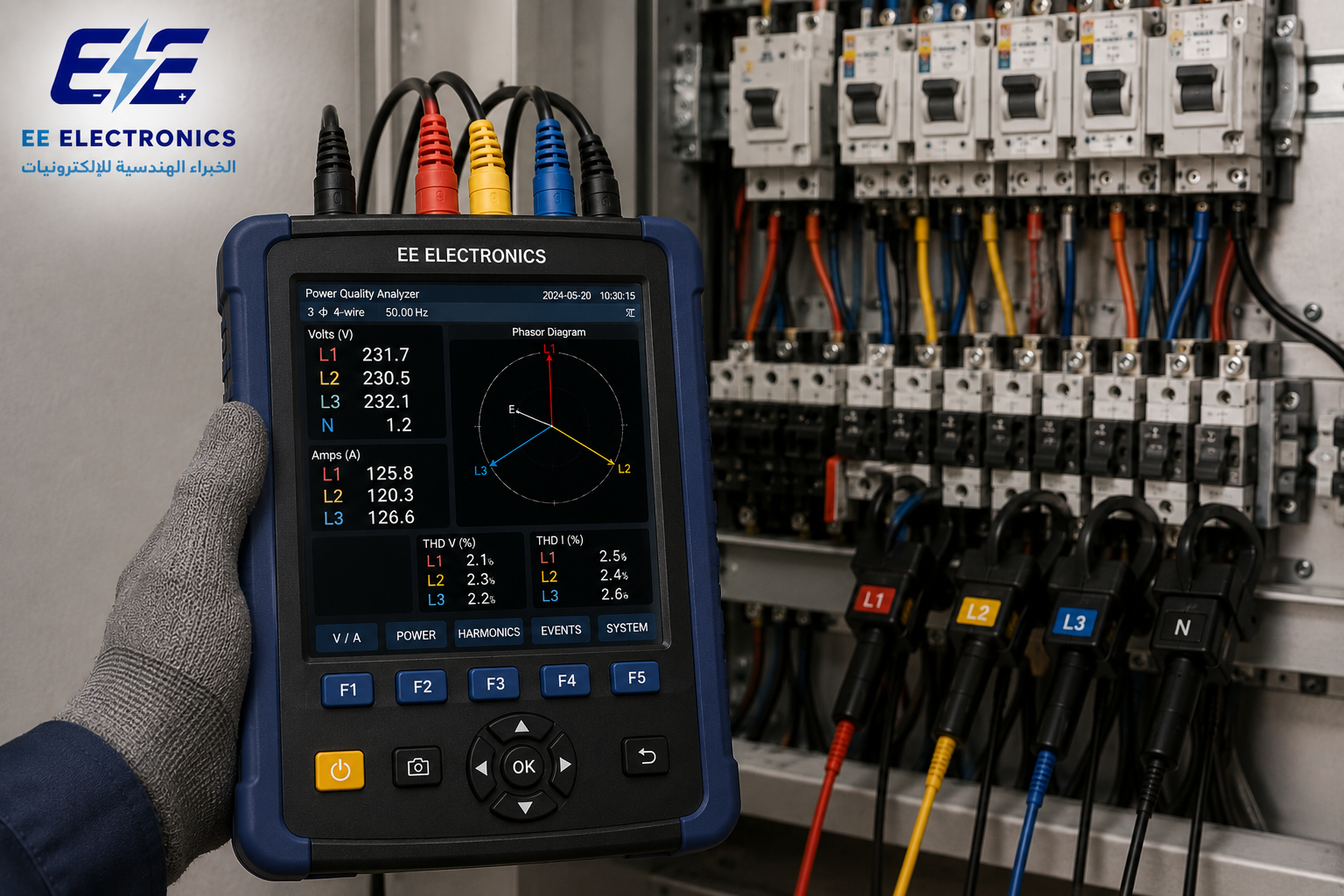
Confirm harmonics and imbalance behind a hot spot.

Record the load current with every thermal image.

Rated PPE for scanning inside live panels.
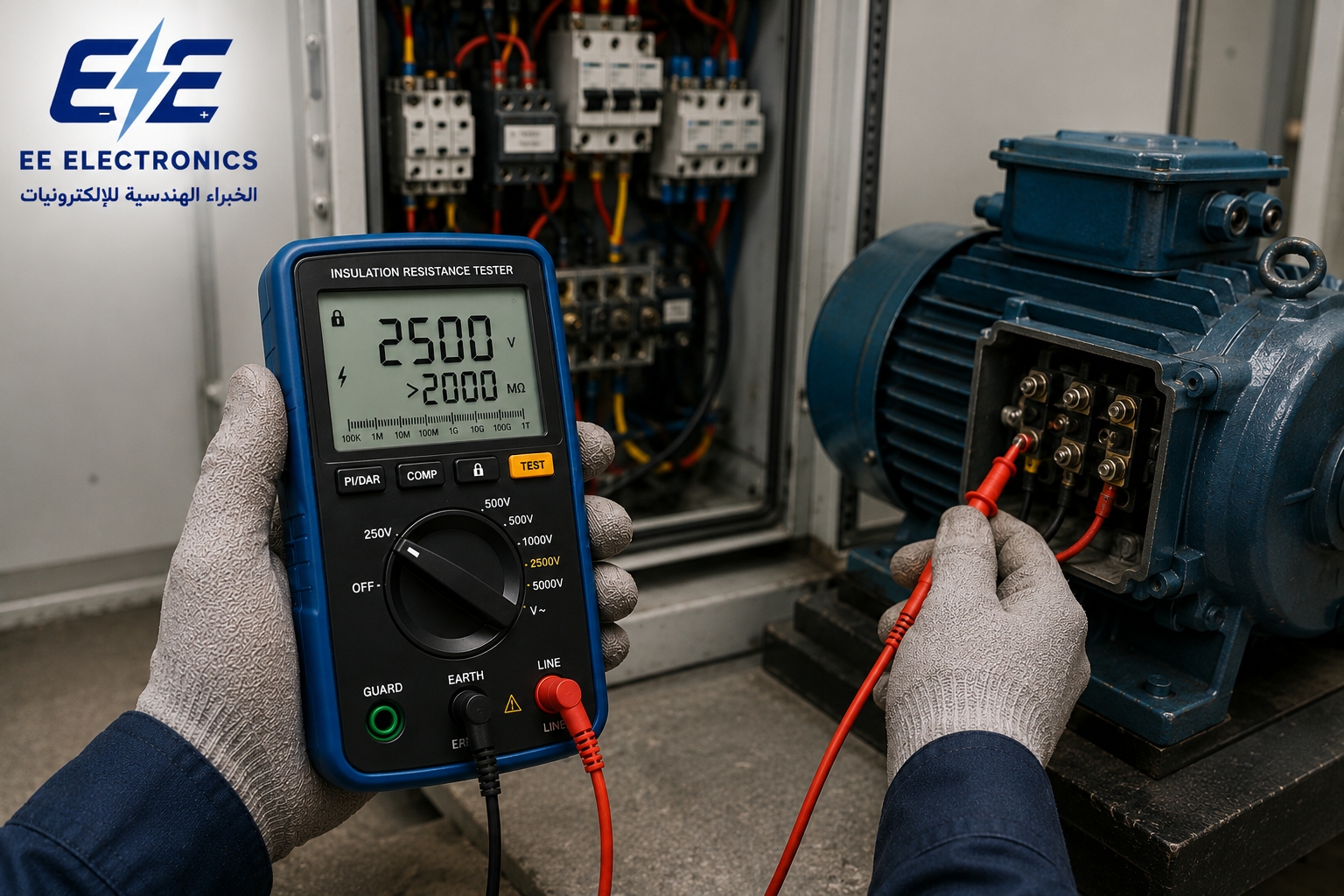
Follow up a thermal finding with an insulation test.
Browse related categories




Frequently asked questions
What resolution thermal camera do I need for electrical inspection?
For close-range work on LV panels, 160×120 is the practical minimum. For professional maintenance of switchgear, MCCs and transformers, 320×240 is the most popular choice. For substations, overhead lines and large solar plants, choose 640×480 or add a telephoto lens.
What temperature difference indicates an electrical problem?
Under NETA criteria, a component 1–3 °C hotter than similar components warrants investigation, 4–15 °C indicates a probable deficiency, and more than 15 °C is a major discrepancy that needs immediate repair. Compare components under similar load.
How often should electrical equipment be inspected with a thermal camera?
NFPA 70B (2023) requires electrical equipment to be inspected at least every 12 months, and equipment in poor condition to have thermography at least every 6 months. In Jordan, the best time for the annual survey is shortly before the summer peak load.
Can a thermal camera see inside a closed electrical panel?
No. Infrared radiation does not pass through panel doors, glass or plastic covers. The panel must be opened by a qualified person wearing the right arc flash PPE, or fitted with infrared inspection windows.
Is a thermal camera better than an infrared thermometer?
For inspection, yes. An infrared thermometer measures one spot, so it only finds a problem if you already know where to aim. A thermal camera shows every hot spot in the panel at once and records a radiometric image for the report.
Can the same thermal camera be used for solar panels?
Yes, for inverters, combiner boxes and small arrays. For large solar plants, cameras with higher resolution, low NETD and drone compatibility make module inspection faster and more reliable.
Where can I buy a thermal imaging camera in Jordan?
EE Electronics supplies thermal imaging cameras from FLIR, Fluke, Testo and other leading brands from its office in Khalda, Amman, with help choosing the right model and local support after purchase. Contact the team for a quote within 24 hours.
Get the right thermal camera, with local support in Jordan
Tell EE Electronics what you inspect, how far away you work and how you report. We will recommend the right thermal imaging camera from FLIR, Fluke, Testo and other leading brands, and reply with a quote within 24 hours.