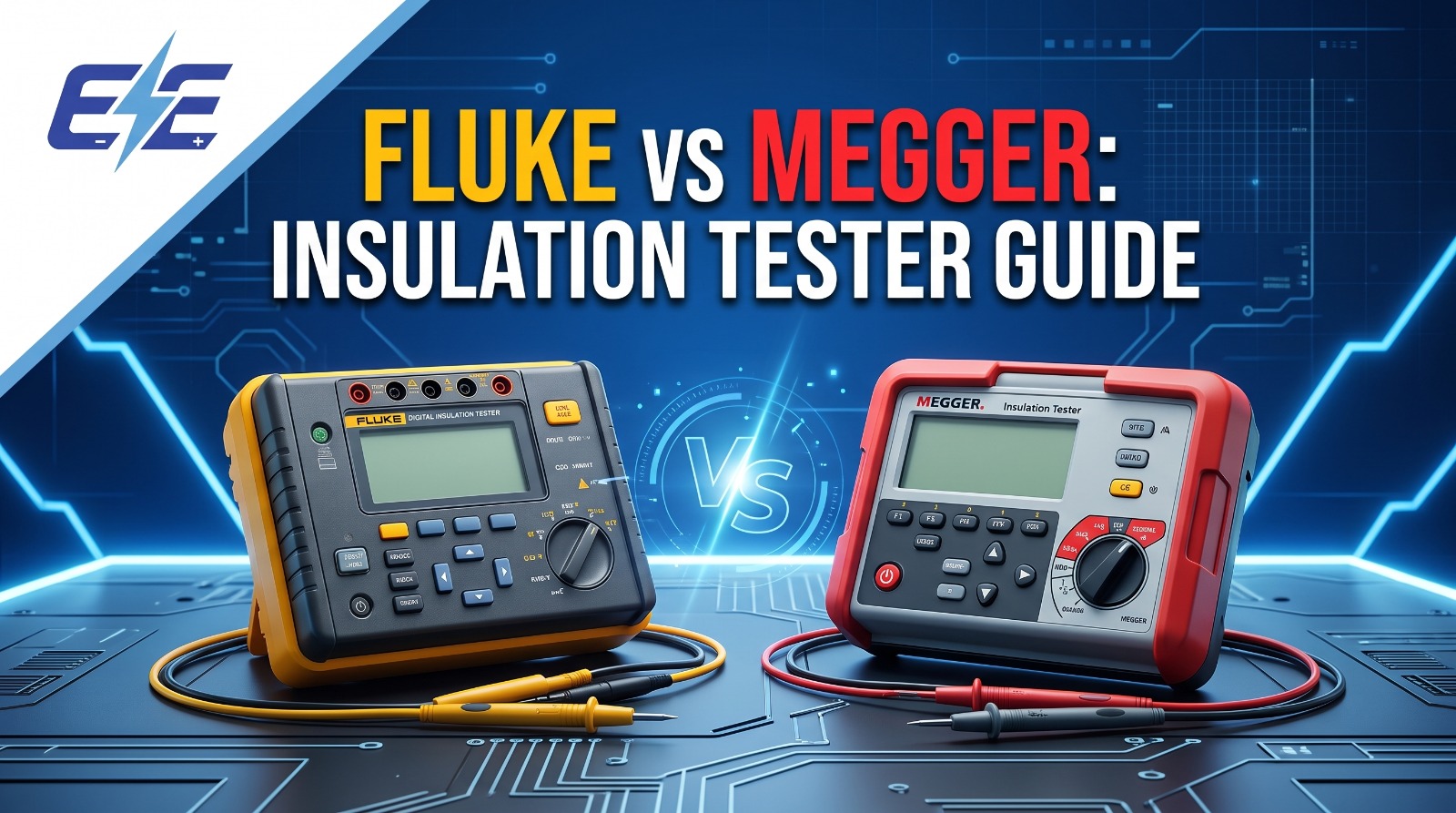
Fluke vs Megger insulation tester, compared class by class from 1 kV to 15 kV: ranges, diagnostic tests, noise rejection and which to buy for your work in Jordan. From EE Electronics, Amman.
In this article
Key takeaways
- Both brands make excellent insulation testers. The right choice depends on the voltage class you test and how you work, not on the logo.
- Up to 1 kV, Fluke stands out for its 2-in-1 insulation multimeter and wireless Fluke Connect; Megger’s MIT400/2 range offers a wider measuring range (up to 200 GΩ) and variable test voltage.
- At 5 and 10 kV, Megger’s diagnostic testers measure higher resistance (15 to 35 TΩ) and reject more interference. Fluke’s 1550C and 1555 are lighter-featured but simple and well connected.
- At 15 kV, Megger is the only one of the two with a tester. Whichever you choose, buy a genuine instrument with a calibration certificate and local support in Jordan.
Fluke vs Megger insulation tester is one of the most common questions engineers and procurement teams ask before ordering. Megger is so closely linked with insulation testing that many engineers in Jordan call every insulation test a “megger test”. Fluke is the brand most electricians already carry in their tool bag. Both make excellent instruments, and both are used every day on Jordan’s substations, factories, solar plants and buildings.
So which should you buy? This comparison from EE Electronics, a supplier of test and measurement equipment in Jordan for more than 30 years, puts current Fluke and Megger insulation testers side by side, voltage class by voltage class, using the manufacturers’ published specifications. It then shows which tester suits which job, and what to check before buying an insulation tester in Jordan. We supply both brands, so the aim is to help you choose the right instrument, not to sell one logo over the other.
Specifications below come from the manufacturers’ published product pages and datasheets as of October 2026. Both brands update their ranges regularly, and some older models are being replaced by new versions, so always check the current datasheet before you order. EE Electronics can confirm the latest model and specification for you.
Fluke vs Megger insulation tester: the overview
The two brands come from different directions. Megger built its name on insulation testing and has a deep range of diagnostic testers for motors, transformers, cables and switchgear, up to 15 kV. Fluke built its name on handheld multimeters and clamp meters and offers insulation testers from the insulation multimeter up to 10 kV, tied into its Fluke Connect wireless system.
| Fluke | Megger | |
|---|---|---|
| Range of test voltages | 50 V to 10 kV | 10 V (variable) to 15 kV |
| Strongest area | Handheld and 1 kV testing; insulation multimeter | Diagnostic testing at 5, 10 and 15 kV |
| Highest resistance (top model) | 2 TΩ (1555 FC) | 35 TΩ (S1-1068/2 and S1-1568/2) |
| Diagnostic tests | PI, DAR; ramp and DD on selected models | PI, DAR, SV, DD, ramp, PDC, PI predictor on advanced models |
| Connectivity | Fluke Connect app on FC models | USB and Bluetooth; PowerDB and CertSuite software |
| Best known for | Ease of use and one ecosystem with Fluke meters | High-voltage diagnostics and interference rejection |
1 kV insulation testers: Fluke 1587 FC and 1507 vs Megger MIT400/2
Most insulation testing in Jordan happens at 500 V and 1000 V: final circuits and distribution boards, LV cables, motors, panels and solar strings. This is where most electricians and maintenance teams buy their first insulation resistance tester.
| Fluke 1587 FC | Fluke 1507 | Megger MIT420/2 | |
|---|---|---|---|
| Type | Insulation multimeter (2-in-1) | Dedicated insulation tester | Dedicated insulation and continuity tester |
| Test voltages | 50, 100, 250, 500, 1000 V | 50, 100, 250, 500, 1000 V | 50, 100, 250, 500, 1000 V, plus variable in 10 V steps |
| Max resistance | 2 GΩ | 10 GΩ | 200 GΩ |
| PI / DAR | Yes | Yes | Yes |
| Safety rating | CAT IV 600 V / CAT III 1000 V | CAT IV 600 V | CAT IV 600 V |
| Also measures | Full multimeter: V, A, Ω, capacitance, frequency, temperature, VFD filter | Voltage, continuity | Voltage, continuity, capacitance |
| Data | Fluke Connect app | Basic | 1000 results stored (MIT420/2); Bluetooth on MIT430/2 |
Which 1 kV tester to choose
- Choose the Fluke 1587 FC if you want one instrument in the tool bag. It is a full true-RMS multimeter and an insulation tester, with a low-pass filter for drives and wireless logging through the Fluke Connect app. Its 2 GΩ limit is enough for pass/fail testing of LV installations.
- Choose the Fluke 1507 if you want a simple, dedicated Fluke insulation tester with a wider range (10 GΩ) and PI/DAR, at a lower cost than the 1587 FC.
- Choose the Megger MIT420/2 or MIT430/2 if you test a lot of motors and cables and want to trend results. The 200 GΩ range shows the difference between good and very good insulation, the variable test voltage covers unusual specifications, and the memory (and Bluetooth on the MIT430/2) makes handover reports easier.
For pass/fail checks against IEC 60364-6 (1 MΩ at 500 V), 2 GΩ is more than enough. For trending motors and cables over the years, a higher range is useful: a reading that drops from 150 GΩ to 20 GΩ is an early warning, while both would simply show as “over 2 GΩ” on a smaller range.
2.5 kV testers: Fluke 1535 and 1537
Between 1 kV and 5 kV, Fluke offers two compact testers that many motor maintenance teams like. Megger covers this level with its 5 kV range, which also tests at 250 V, 500 V, 1000 V and 2500 V.
| Fluke 1535 | Fluke 1537 | |
|---|---|---|
| Test voltages | 250, 500, 1000, 2500 V | 250 V to 2500 V in 100 V steps |
| Max resistance | 500 GΩ | 500 GΩ |
| PI / DAR | Yes | Yes, plus dielectric discharge (DD) |
| Short-circuit current | >2 mA | >5 mA |
| Extra functions | — | Ramp test, timer, voltage and resistance measurement, memory with USB download |
| Safety rating / power | CAT IV 600 V; 8 × AA | CAT IV 600 V; 8 × AA |
A 2.5 kV tester suits LV and medium motors, generators and cables up to about 5 kV rated voltage. If your work includes 11 kV motors or 11 kV and 33 kV cables, go straight to a 5 kV or 10 kV tester.
Choosing between Fluke and Megger?
Tell EE Electronics what you test and at what voltage. Our engineers will recommend the right Fluke or Megger insulation tester and send a quotation within 24 hours.
5 kV insulation testers: Fluke 1550C vs Megger MIT525/2 and S1-568/2
5 kV is the workhorse class for MV maintenance: 11 kV motors and generators, transformers, MV switchgear and cables. Here the Megger vs Fluke difference becomes clear. All three testers below come from the MV/HV test equipment world, and all are sold as 5 kV, 10 kV and 15 kV insulation testers.
| Fluke 1550C FC | Megger MIT525/2 | Megger S1-568/2 | |
|---|---|---|---|
| Test voltages | 250 V to 5 kV (50 V steps to 1 kV, then 100 V) | 250, 500, 1000, 2500, 5000 V; user-defined from 40 V | 250, 500, 1000, 2500, 5000 V; user-defined |
| Max resistance | 1 TΩ | 15 TΩ | 15 TΩ |
| Diagnostic tests | PI, DAR, ramp, timer | PI, DAR, SV, DD, ramp, PDC, PI predictor | PI, DAR, SV, DD, ramp, PDC, PI predictor |
| Noise rejection | Not stated | 6 mA | 8 mA |
| Safety rating | CAT IV 600 V / CAT III 1000 V | CAT IV 600 V | CAT IV 600 V |
| Battery | Lead-acid; 750+ tests per charge | Li-ion; about 6 h at 5 kV; runs on mains | Li-ion; about 6 h at 5 kV; runs on mains |
| Data | 99 results; Fluke Connect | USB and Bluetooth; time-stamped logging | USB and Bluetooth; logging with temperature and humidity |
| Enclosure | Compact case, 3.7 kg | IP65 with lid closed | IP65 with lid closed |
Why resistance range and noise rejection matter
New or dry MV insulation, such as a new transformer, a new cable or a clean bushing, can read well above 1 TΩ at 5 kV. A tester that tops out at 1 TΩ shows “over range” and cannot tell you whether the insulation is excellent or just good, and the PI calculation loses meaning when both readings are over range. A 15 TΩ range keeps the numbers measurable, which matters when you trend results year to year.
Noise rejection matters in live substations. A de-energised cable or busbar next to energised equipment picks up induced currents that disturb the measurement. Megger rates the MIT525/2 at 6 mA and the S1 range at 8 mA of interference rejection, which is why they are popular for testing in busy 132/33 kV substations.
Which 5 kV tester to choose
- Fluke 1550C FC: for maintenance teams that test motors, cables and switchgear on a schedule, want simple operation, PI/DAR and Fluke Connect, and do not need diagnostic tests beyond PI.
- Megger MIT525/2: for substation and commissioning teams that need step voltage and dielectric discharge tests, a 15 TΩ range and good noise rejection.
- Megger S1-568/2: for testing companies and utilities that work in high-interference substations and want the highest noise rejection, environmental sensors and the most complete reporting.
10 kV and 15 kV testers: Fluke 1555 vs Megger MIT1025/2 and S1 range
10 kV testers are used on 33 kV cables and switchgear, large transformers, generators and HV motors, where IEEE 43 recommends test voltages of 5 kV to 10 kV for machines rated above 12 kV. 15 kV testers are mainly used by utilities, transmission contractors and testing companies.
| 1555 FC | MIT1025/2 | S1-1068/2 | S1-1568/2 | |
|---|---|---|---|---|
| Max test voltage | 10 kV | 10 kV | 10 kV | 15 kV |
| Max resistance | 2 TΩ | 20 TΩ | 35 TΩ | 35 TΩ |
| Diagnostic tests | PI, DAR | Full set* | Full set* | Full set* |
| Noise rejection | Not stated | See datasheet | 8 mA | 8 mA |
| Safety rating | CAT IV 600 V | CAT IV | CAT IV 600 V | CAT IV 1000 V |
* Full set: PI, DAR, step voltage (SV), dielectric discharge (DD), ramp, PDC and PI predictor.
The pattern is the same as at 5 kV, only stronger: the Fluke 1555 FC is a capable, connected 10 kV tester for maintenance work, while Megger’s 10 kV and 15 kV testers are built for diagnostics. At 15 kV, Megger is the only option of the two.
Fluke vs Megger insulation tester: which to buy for your work
Start with the highest voltage you test and the depth of diagnosis you need. This table sums up our recommendation for typical teams in Jordan.
| Who you are | Fluke option | Megger option | Our view |
|---|---|---|---|
| Electrician, building and LV installations | 1587 FC (one meter for everything) | MIT420/2 or MIT430/2 (wider range, memory) | Either; choose by ecosystem |
| Solar PV installer (strings up to 1500 V DC) | Dedicated PV tester | Dedicated PV tester | Use a PV tester, see note below |
| Plant maintenance: LV and MV motors | 1537 or 1550C FC | MIT525/2 | Fluke for simple routine tests; Megger for diagnostics |
| Substation and MV cable commissioning | 1550C FC or 1555 FC | MIT525/2, MIT1025/2, S1 range | Megger, for range and noise rejection |
| Testing company or utility, up to 15 kV | — | S1-1068/2 or S1-1568/2 | Megger |
For solar plants, a dedicated PV tester measures insulation resistance on DC strings together with open-circuit voltage, short-circuit current and polarity, to IEC 62446-1. EE Electronics supplies solar PV testing equipment for this work. For general installations, a multifunction installation tester adds RCD, loop and earth tests to the insulation test.
How to pick the test voltage
The voltage class you need follows from the equipment you test. For rotating machines, IEEE 43 recommends:
| Rated winding voltage | DC test voltage | Tester class |
|---|---|---|
| Below 1,000 V | 500 V | 1 kV tester |
| 1,000 to 2,500 V | 500 to 1,000 V | 1 kV tester |
| 2,501 to 5,000 V | 1,000 to 2,500 V | 2.5 kV or 5 kV tester |
| 5,001 to 12,000 V (e.g. 11 kV motors) | 2,500 to 5,000 V | 5 kV tester |
| Above 12,000 V | 5,000 to 10,000 V | 10 kV tester |
Our article on how to choose an insulation resistance tester explains these voltages, PI and DAR limits and the minimum values for each type of equipment in more detail. For MV cables, insulation resistance is only the first test; see VLF cable testing for the withstand test that follows. For transformers, the insulation test is part of a set that includes the TTR test and winding resistance.
Common mistakes when buying an insulation tester
Most regrets after a Fluke vs Megger insulation tester purchase have nothing to do with the brand. They come from these mistakes:
- Buying by brand alone. A Fluke 1 kV tester and a Megger 1 kV tester are closer to each other than either is to a 5 kV tester. Choose the class first.
- Buying too low a voltage. A 1 kV tester cannot test an 11 kV motor or a 33 kV cable properly. Check the IEEE 43 table and your specifications.
- Ignoring the resistance range. On MV equipment, a tester that reads “over range” cannot trend insulation or calculate a meaningful PI.
- Forgetting interference. In energised substations, low noise rejection gives unstable or wrong readings.
- Using leads with a lower CAT rating than the tester. The leads must match the instrument’s rating.
- Buying from an unknown source. A grey-market or counterfeit unit may have no valid warranty in Jordan and no calibration certificate.
Buying a Fluke or Megger insulation tester in Jordan
Jordan’s electrical work spans every voltage class: 400/230 V installations in buildings and factories, 11 kV and 33 kV distribution run by JEPCO, IDECO and EDCO, 132 kV and 400 kV transmission run by NEPCO, and a large fleet of solar and wind plants. A contractor or maintenance team often needs more than one class of insulation tester, and sometimes both brands.
Whether you settle on a Fluke insulation tester or a Megger insulation tester, the same buying rules apply. Fluke itself warns that counterfeit test tools can fail to protect the user, and that warranty service depends on buying through authorised channels in the country of purchase. Our article on buying test equipment in Jordan sets out ten checks to make before you order, and our electrical testing equipment list for Jordan shows what else each type of team needs.
- Genuine instrument with its serial number and full scope of supply.
- Calibration certificate accepted by your consultant or utility.
- Leads and accessories rated for your work, including HV leads for 5 kV and above.
- Clear quotation in Jordanian dinars, stating whether the 16% general sales tax is included.
- Local support for recalibration, spares and training.
Need a quotation for Fluke or Megger in Jordan?
Send EE Electronics the model you have in mind, or simply what you need to test. We will reply with the right option from either brand, the full scope of supply and the delivery time within 24 hours.
Fluke and Megger insulation testers from EE Electronics
EE Electronics has supplied test and measurement equipment in Jordan for more than 30 years, from its office in Khalda, Amman. We supply both Fluke and Megger, together with other leading brands such as Kyoritsu, Hioki, Metrel, Sonel and Chauvin Arnoux, so we can recommend the tester that fits your work rather than the one brand we happen to carry. See all the brands we supply.
- Honest comparison: Fluke, Megger and other brands quoted side by side when you are not sure.
- Every voltage class: from 1 kV insulation multimeters to 15 kV diagnostic testers.
- Complete kits: insulation testers with multimeters, clamp meters, earth testers and MV test equipment in one quotation.
- Calibration certificate with the instrument, and support from our Amman office.
- Training through our electrical testing and commissioning training.
Need insulation testing as a service?
For one-off tests and commissioning, our partner AQ Electric provides on-site testing across Jordan and the region, including solar PV testing in Jordan to IEC 62446-1.
Insulation testers and related instruments in Jordan
Fluke, Megger and other leading brands, with calibration certificates and local support from Amman.
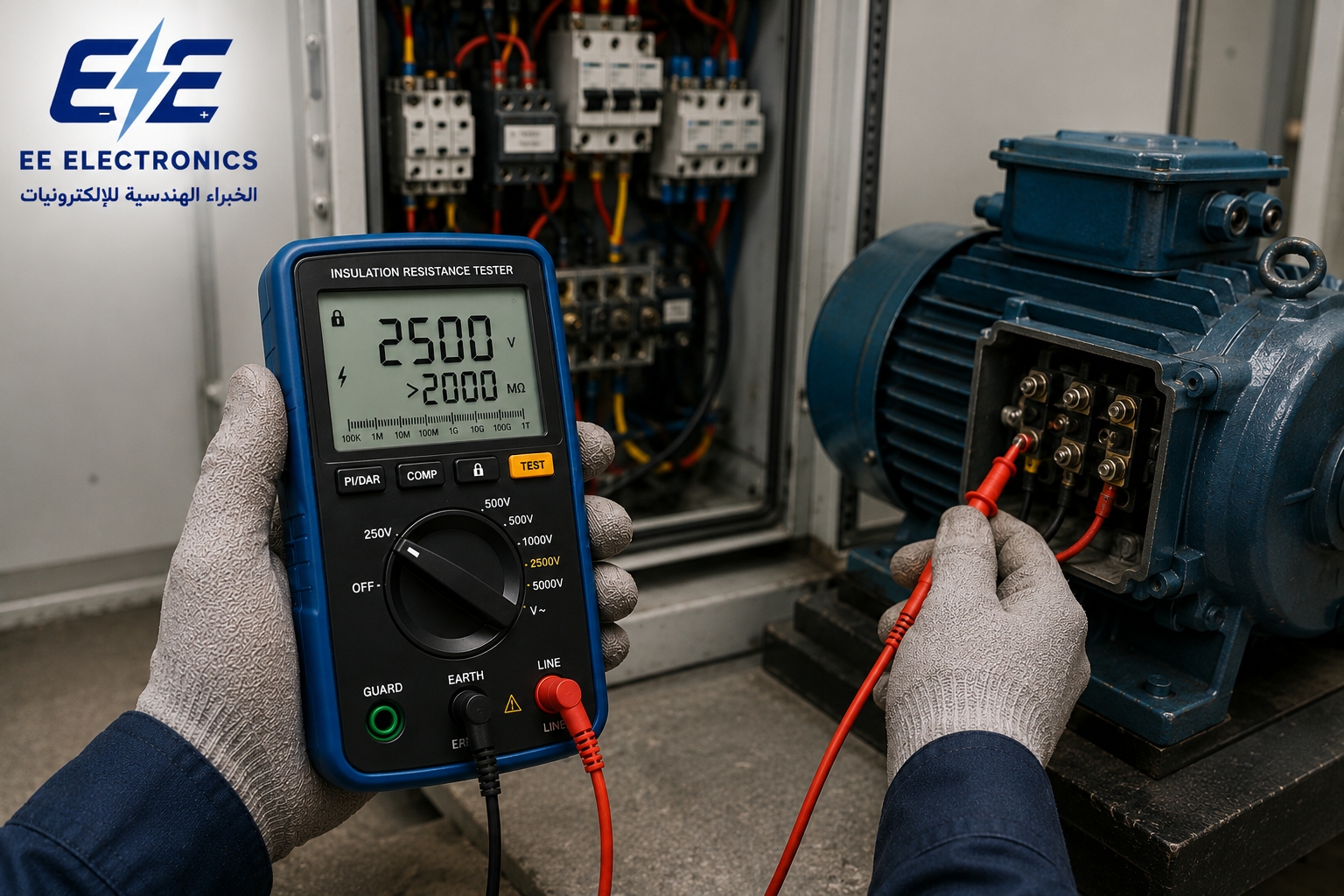
Handheld 1 kV and 2.5 kV testers.
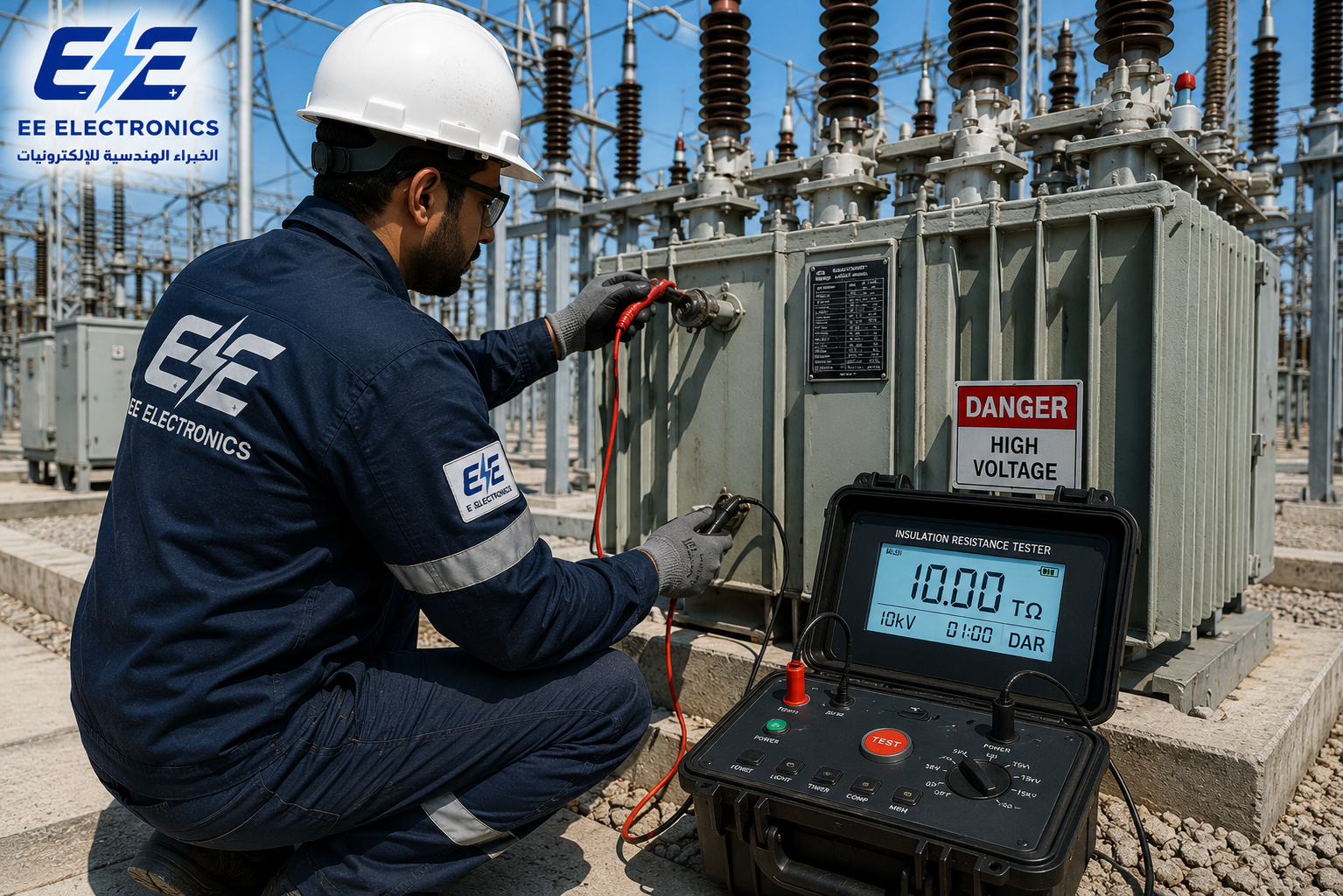

Including insulation multimeters.

Electrical Installation Testers
Insulation, RCD, loop and earth in one.
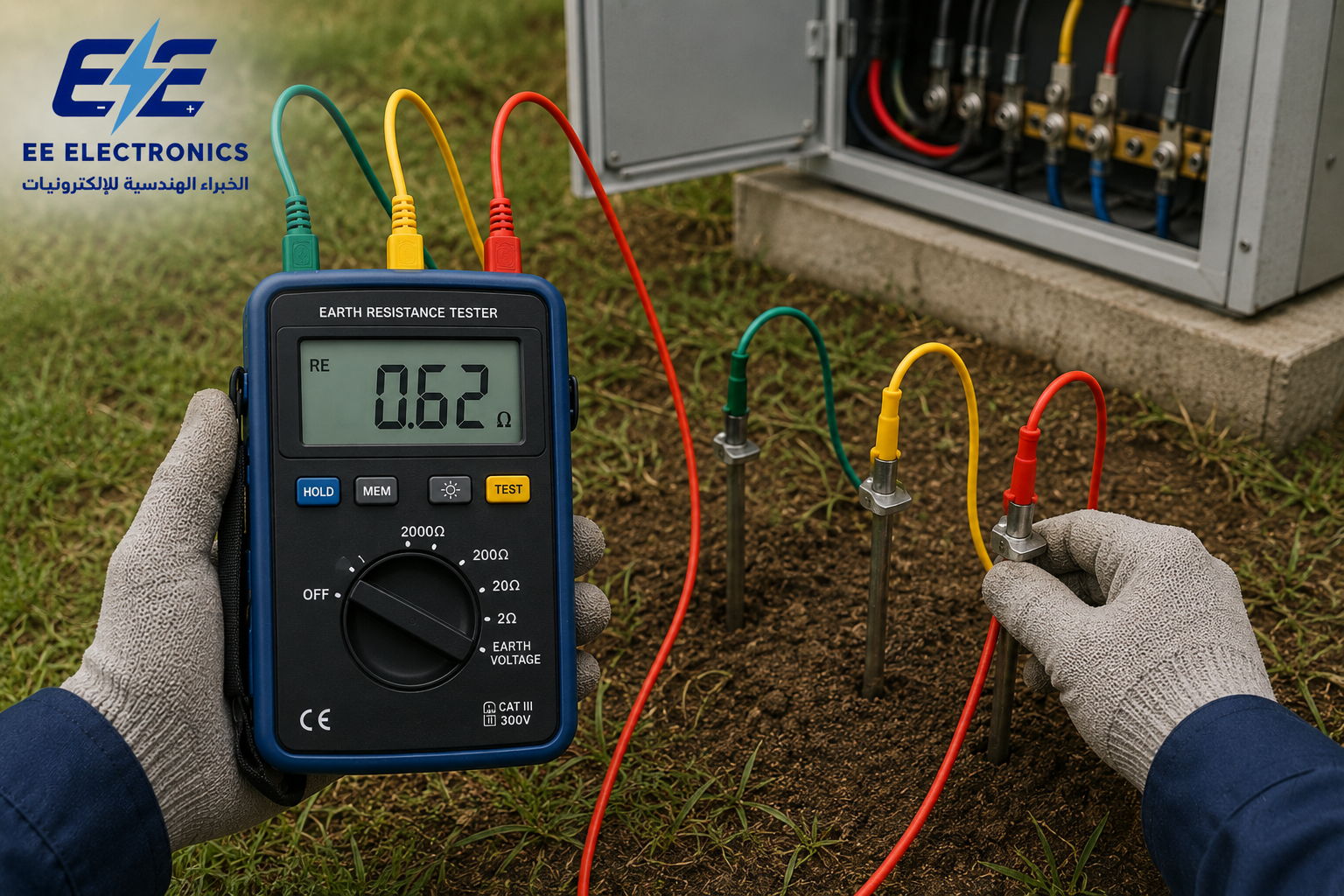
Earthing systems and electrodes.
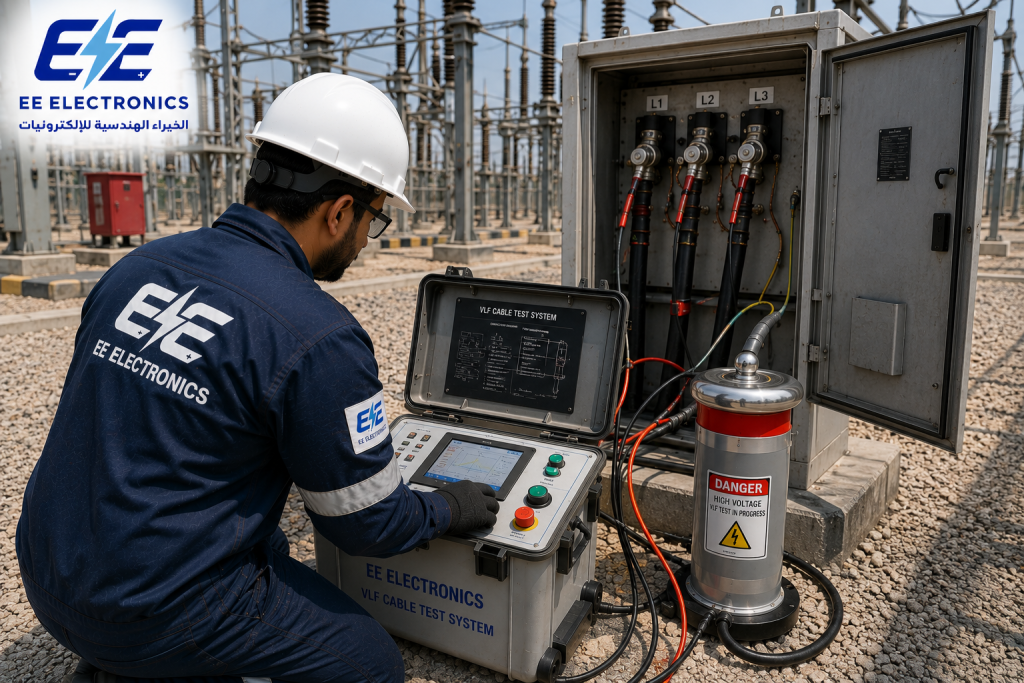
Withstand testing after the IR test.
Browse by category
 Electrical & Electronic EquipmentMultimeters, clamp meters, IR and earth testers
 MV/HV Test Equipment5–15 kV IR testers, VLF, transformer testing
 Solar PV Testing EquipmentPV testers, IV curve tracers
 Measurement & CalibrationElectrical, process and temperature calibrators
 Safety & Protection EquipmentHV detectors, gloves, earthing sets
 Training & Engineering SolutionsTesting, calibration and safety training
Frequently asked questions
Fluke vs Megger insulation tester: which is better?
Neither is better for every job. Fluke is strongest in handheld and 1 kV testing, with its 2-in-1 insulation multimeter and Fluke Connect. Megger has the deeper range of 5, 10 and 15 kV diagnostic testers, with higher resistance ranges and stronger noise rejection. Choose by the voltage class you test.
Why do engineers call an insulation tester a megger?
Megger made some of the first portable insulation testers, and the brand name became a common word for the instrument and the test. Today “megger test” usually means any insulation resistance test, whatever the brand of tester.
Which Fluke insulation tester is best for electricians?
The Fluke 1587 FC suits electricians who want one instrument: a full multimeter with insulation testing from 50 V to 1000 V. The Fluke 1507 is a simpler dedicated insulation tester with a 10 GΩ range.
Which Megger insulation tester should I buy for 11 kV equipment?
For 11 kV motors, generators, cables and switchgear, a 5 kV tester such as the Megger MIT525/2 or S1-568/2 is the usual choice. IEEE 43 recommends 2.5 to 5 kV for machines rated 5 to 12 kV.
Does Fluke make a 15 kV insulation tester?
No. Fluke’s insulation testers go up to 10 kV with the 1555 FC. For 15 kV testing, Megger offers the S1-1568/2 and its 15 kV MIT range.
What is the difference between a 1 TΩ and a 15 TΩ tester?
The range decides how high a resistance the tester can measure before it shows over range. New or dry MV insulation can exceed 1 TΩ at 5 kV, so a higher range is needed to trend the insulation and calculate a meaningful PI.
Where can I buy Fluke and Megger insulation testers in Jordan?
EE Electronics supplies Fluke and Megger insulation testers, from 1 kV insulation multimeters to 15 kV diagnostic testers, from its office in Khalda, Amman, with calibration certificates and local support. Send your requirement for a quotation within 24 hours.
Fluke or Megger? Let us help you choose.
Tell EE Electronics what you test and at what voltage. We will recommend the right insulation tester from either brand and reply with a quotation within 24 hours.